

LinkedIn offers B2B businesses something few other platforms can: direct access to the people who influence purchasing decisions. That’s why having a clear LinkedIn B2B marketing strategy is so important for businesses that want to generate leads, build credibility, and support long-term growth.
Whether you’re selling professional services, software, manufacturing solutions, your next customer is likely to research your business long before they make contact. They’ll read your content, visit your profile, explore your company page, and decide whether your business feels credible enough to learn more. Yet many businesses struggle to turn that opportunity into consistent results.
Some publish content regularly and keep themselves visible but generate very little engagement. Others invest in advertising before establishing a clear message. Many simply create a company page and expect enquiries to follow. The problem usually isn’t effort. It’s that these activities are treated as separate tasks instead of parts of the same strategy.
A successful LinkedIn B2B marketing strategy isn’t built around one feature or tactic. It comes from creating a professional presence, sharing content that demonstrates expertise, building relationships with the right people, and using advertising to expand what’s already working. Each element supports the next, helping businesses become more visible, more recognisable, and ultimately more likely to be considered when a buying decision is made.
This guide explains how those elements fit together, providing a practical framework for developing a LinkedIn marketing strategy for B2B organisations that supports long term business growth.
What Is a LinkedIn B2B Marketing Strategy?
A LinkedIn B2B marketing strategy is a structured approach to using LinkedIn as part of your wider marketing and business development activity. Rather than treating the platform as somewhere to occasionally publish updates or make new connections, it brings together every activity that shapes how your business is discovered, understood, and remembered.
Think about how a typical buying journey unfolds.
A decision maker might first notice one of your posts while scrolling through their feed. A few weeks later, they remember your name after seeing someone else engage with your content. They visit your profile, browse your company page, and return to your website before eventually reaching out when the timing is right.
None of those interactions happen in isolation. Each one builds on the last. Every profile, conversation, and campaign contributes to the impression your business leaves behind.
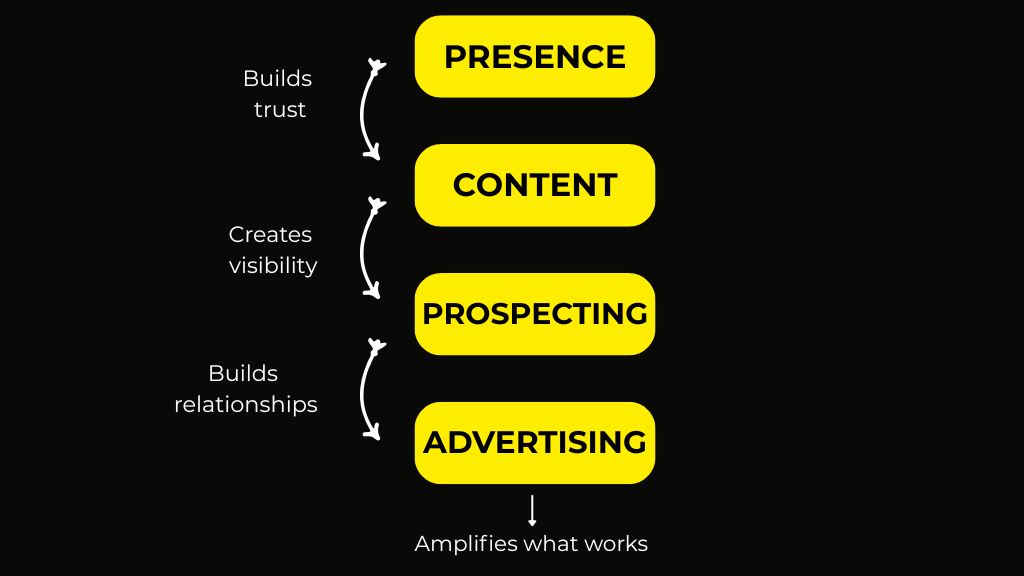
Throughout this guide, we’ll explore four connected pillars that form the foundation of a successful strategy:
- Presence: Creating professional profiles and company pages that build confidence from the very first visit.
- Content: Sharing useful insights that demonstrate expertise and keep your business visible.
- Prospecting: Developing genuine relationships with the people most likely to become customers.
- Advertising: Using paid campaigns to amplify content and messaging that’s already proving effective.
Why LinkedIn Matters for B2B Businesses
B2B purchasing decisions rarely happen after a single interaction.
Instead, trust develops gradually through repeated exposure. Someone might discover your business through an article, return after seeing another post, visit your profile following a recommendation, and only reach out once a genuine need arises.
LinkedIn supports that journey remarkably well. Unlike many social platforms, people use LinkedIn to solve business problems, discover new ideas, and connect with professionals they respect. Expertise is expected, which gives businesses an opportunity to demonstrate their knowledge before a sales conversation has even begun.
This makes LinkedIn particularly valuable for organisations selling higher value products or services, where credibility often influences buying decisions as much as price or features. LinkedIn gives potential customers more opportunities to encounter your expertise throughout their buying journey.
The businesses that achieve the strongest results understand that every interaction contributes to the bigger picture. That starts with the first impression your business creates.
Presence: Building Trust Before the Conversation Starts
Before someone reads your latest post or accepts a connection request, they’ll often do something much simpler: they’ll check who you are. A quick visit to your profile or company page is often enough for someone to decide whether your business feels credible, relevant, and worth exploring further. Those first impressions don’t need to answer every question, but they should make it immediately clear what you do, who you help, and why your expertise matters. Without that foundation, every other part of your LinkedIn B2B marketing strategy has to work harder.
Personal Profiles: Where Relationships Begin
Personal profiles are often where B2B relationships start. They’re also often businesses’ strongest asset on LinkedIn.
People naturally connect with individuals before they connect with brands, especially when they’re looking for expertise or evaluating potential suppliers. A founder sharing industry insights or a consultant explaining a common challenge will often attract more attention than the same message published from a company page.
That makes your profile very valuable. It should quickly answer three questions:
- What do you do?
- Who do you help?
- Why should someone trust your expertise?
Your headline is usually the first opportunity to communicate those answers. Rather than simply stating your job title, it should explain the value you create and the audience you support. If you’re reviewing your profile, refining your LinkedIn headline is often the most effective place to begin.
The rest of your profile should reinforce that message. Your About section, Featured content, experience, and recent activity should all work together to create a clear and consistent picture of your expertise. When someone discovers you through a post or recommendation, your profile should make it easy for them to understand why they should keep following your work.
Make Every Profile Element Work Together
The strongest LinkedIn profiles feel cohesive from top to bottom. Think about how someone experiences your profile as a whole. A professional photo creates confidence. Your headline explains your value. The About section adds context. Your Featured section highlights resources that reinforce your expertise, while a well-designed banner immediately strengthens your personal brand before someone has even started reading.
If you’re updating your profile, getting the LinkedIn banner size right is a simple way to create a more polished first impression. The Featured section also deserves particular attention. It allows you to guide visitors towards the content that best represents your work, whether that’s a case study, a guide, a client success story, or one of your strongest articles. Making the most of your LinkedIn Featured section helps ensure your most valuable content doesn’t disappear into your activity feed.
Why Your Company Page Still Matters
Although personal profiles often create the first connection, company pages provide reassurance.
Prospects frequently check company pages before making contact, particularly when comparing several suppliers. An active, well-maintained page signals that your business is established, engaged, and invested in its professional presence.
At a minimum, your company page should include:
- clear branding and visuals;
- an up-to-date company description;
- accurate information about your services;
- regular, relevant updates;
- consistent messaging that reflects your wider brand.
Your company page shouldn’t compete with personal profiles. Instead, the two should reinforce one another. Someone might discover your business through a founder’s post, then visit the company page to learn more before deciding whether to get in touch.
Create a Consistent Team Presence
As businesses grow, sales teams, consultants, technical specialists, and senior leaders all contribute to how the organisation is perceived. Each person brings their own voice, experience, and perspective, helping the business reach different audiences.
Consistency matters more than uniformity. Employees don’t need identical profiles or posting styles, but they should share a clear understanding of the company’s positioning, audience, and areas of expertise. That makes every interaction feel connected, regardless of who someone encounters first.
If your team regularly attends networking events, conferences, or exhibitions, sharing your LinkedIn QR code can also make it quicker and easier for new contacts to connect with the right people.
Your Presence Sets the Standard
Every LinkedIn interaction begins with a first impression.
People rarely decide to work with a business because of one perfectly written profile. They decide because every interaction reinforces the same impression of expertise, professionalism, and credibility. A strong presence gives the rest of your LinkedIn marketing strategy something solid to build on.
Content: Staying Visible Between Conversations
A strong profile creates a positive first impression. Content gives people a reason to remember your business after that first visit.
For most B2B organisations, prospects aren’t ready to buy the first time they come across your company. They might be researching a challenge, comparing companies, or simply looking for useful ideas. Consistently sharing valuable content helps you stay visible throughout that process without relying on constant sales conversations.
That’s why the businesses that perform well on LinkedIn rarely disappear for weeks before returning with another promotional post. They become familiar because they’re consistently contributing something useful.
Start With the Knowledge You Already Have
One of the biggest challenges businesses face isn’t creating content but deciding what content to create.
Instead of asking “What should we post today?”, ask a different question:
“What do our customers ask us every week?”
Those conversations are often the best source of content ideas. Think about the questions you answer during sales meetings, the misconceptions you regularly correct, or the advice you give clients that could benefit a wider audience. Chances are, you’ve already got months of valuable content without realising it. Building your content around existing knowledge also makes it much easier to stay consistent. You’re sharing expertise your business already has, rather than trying to invent new topics every week.
If you’re still struggling for ideas, check out some LinkedIn Post Ideas for Personal Pages.
Give Your Content a Clear Purpose
Successful LinkedIn content isn’t random. It usually falls into a small number of themes that reflect both your expertise and your audience’s interests.
For example, you might regularly share:
- practical advice that helps customers solve common problems;
- commentary on industry developments;
- lessons learned from projects or client work;
- behind-the-scenes insights into your business;
- opinions that demonstrate your experience.
Working within a handful of themes makes planning easier while helping your audience understand what your business is known for.
Focus on Helping, Not Selling
Many businesses still treat LinkedIn as another place to promote their services. The most effective content takes a different approach.
Instead of leading with what you sell, focus on what your audience wants to learn. Explain a process. Break down a common challenge. Offer practical advice that someone can genuinely use. That doesn’t mean every post needs to be an in-depth guide. A simple observation, a lesson from experience, or a fresh perspective can be just as valuable when it helps your audience think differently. Over time, those individual posts build something much bigger than engagement. They establish your business as a reliable source of useful information.
Consistency Creates Momentum
Businesses often ask how frequently they should post on LinkedIn. The truth is, there’s no universal answer.
Publishing every day won’t produce better results if the content lacks quality, while posting once every few weeks makes it difficult to stay visible. The goal is finding a realistic rhythm that your team can maintain over time.
Understanding how the LinkedIn algorithm works can also help you make better decisions about consistency, as regular, relevant activity is far more likely to keep your content visible than occasional bursts of posting.
Use Different Formats for Different Ideas
Not every idea works best as a text post. Some topics are easier to explain through a carousel. Others are better suited to video, while longer resources can be shared as downloadable documents.
Using different formats keeps your content varied while allowing you to communicate ideas more effectively.
For example:
- text posts are ideal for opinions and observations;
- carousel posts work well for step-by-step guidance;
- videos add personality and help audiences connect with the people behind your business;
- documents can support lead generation by providing more detailed resources.
If you’re creating video content, using the correct LinkedIn video size and ratio helps ensure it appears professionally across the platform. More broadly, understanding how to use video for social media can help you get more value from every video you produce.
Measure What Really Matters
Likes are easy to count, but they rarely tell the full story.
A post that generates fewer reactions may still deliver greater business value if it encourages profile visits, starts conversations, or reaches the right audience. That’s why it’s important to look beyond surface-level engagement.
Metrics such as LinkedIn impressions provide useful insight into how many people are actually seeing your content, helping you understand whether your visibility is growing over time.
Rather than asking “Did this post perform well?”, ask:
“Did it reach the right people and encourage them to learn more about our business?”
That’s a much more meaningful measure of success.
Every Post Builds Something Bigger
Individual posts seldom change a business on their own.
Consistency is what creates momentum. Every useful post becomes another opportunity for someone to discover your expertise, remember your business, or return when the timing is right. Over time, the growing library of content becomes one of your strongest marketing assets.
Prospecting: Turning Visibility Into Relationships
Creating content helps people discover your business. Prospecting builds on that awareness by starting conversations with the people who are most likely to benefit from your expertise. Done well, it doesn’t feel like selling. It feels like professional networking with purpose.
Start With the Right People
Effective prospecting begins with knowing exactly who you’re trying to reach.
Think about your ideal customers. What industries do they work in? How large are their organisations? Which job titles influence buying decisions? What challenges are they trying to solve? The clearer your answers, the easier it becomes to focus your time on conversations that are genuinely relevant.
It’s easy to assume a larger network will produce better results. In reality, a smaller network of well-matched contacts is far more valuable than thousands of connections who will never become customers, collaborators, or advocates. Relevance almost always beats volume.
Build Relationships Before Opportunities
One of the quickest ways to undermine LinkedIn prospecting is trying to sell too soon.
Most people don’t accept a connection request hoping to receive a sales message a few minutes later. Instead, approach LinkedIn the way you would any professional networking event. Join conversations. Respond to posts. Share useful insights. Ask thoughtful questions. Those small interactions make future conversations feel natural because your name is already familiar. Relationships built this way tend to be stronger, more productive, and far more enjoyable for everyone involved.
Use LinkedIn’s Search Tools Strategically
LinkedIn’s search filters make it much easier to identify relevant decision-makers.
You can narrow results by industry, location, company size, seniority, and job title, helping you build a network that’s aligned with your business goals. For organisations carrying out regular outreach, Sales Navigator adds even more advanced filtering, lead management, and account tracking capabilities.
The technology helps you identify the right people. The relationship still depends on how you approach them.
Quality Beats Quantity
Growing your LinkedIn network isn’t the same as collecting as many connections as possible. LinkedIn even places limits on connection requests, encouraging users to build genuine professional networks rather than sending requests indiscriminately. Understanding the LinkedIn connection request limit can help you plan outreach more effectively while avoiding unnecessary restrictions.
Focus on connecting with people who genuinely fit your audience, contribute to your industry, or influence the conversations you want to be part of. Over time, those connections increase the reach of your content, introduce you to new opportunities, and strengthen your professional reputation.
Let Your Content Do Some of the Work
Content opens the door. Prospecting starts the conversation.
Someone may have seen one of your posts, read an article, or noticed your comments on another discussion before you ever send a connection request. That familiarity changes the conversation.
Instead of introducing yourself from scratch, you’re building on an impression that already exists. Content creates visibility. Prospecting turns that visibility into relationships. Once those relationships are developing consistently, advertising becomes a powerful way to introduce your business to even more of the right people.
Advertising: Amplifying What Already Works
Advertising can dramatically increase your reach on LinkedIn, but it delivers the strongest results when it’s supporting a strategy that’s already working.
If your profiles are clear, your content resonates with your audience, and you’re building meaningful relationships, paid campaigns can help you scale those successes. Without those foundations, advertising often becomes a faster way to spend budget rather than generate results.
Define Success Before Spending Budget
Every campaign should begin with a clear objective.
Are you trying to increase awareness?
Generate enquiries?
Promote an event?
Drive downloads of a guide?
Choosing the outcome first makes every other decision much easier, from audience targeting through to campaign format and creative.
Reach the Right Audience
One of LinkedIn’s biggest strengths is its professional targeting.
You can reach people based on factors such as industry, company size, job title, seniority, skills, and location. This precision means you don’t need enormous audiences. It’s tempting to make your audience as large as possible, but in practice, broader isn’t usually better. Reaching the right decision makers consistently will almost always outperform reaching more people who were never likely to become customers in the first place.
Choose the Format That Fits the Objective
LinkedIn offers a wide range of advertising options, each suited to different goals.
Thought Leader Ads can extend the reach of posts published by senior leaders and subject matter experts.
Document Ads are particularly effective when promoting guides, reports, or other educational resources.
Image, video, and carousel campaigns work well for increasing visibility, while Dynamic Ads provide more personalised experiences.
Choose the one that best supports what you’re trying to achieve.
Measure Business Impact
It’s easy to become focused on campaign metrics such as impressions, clicks, and engagement. Those numbers are useful, but they’re only a small part of the bigger picture.
The more important question is whether your campaigns are contributing to wider business objectives.
Are the right people visiting your website?
Are more prospects engaging with your content?
Are conversations increasing?
Understanding LinkedIn advertising costs also helps put campaign performance into context. Pairing that with your LinkedIn SSI score gives you a clearer picture of whether your paid campaigns are supporting your wider LinkedIn presence and whether your investment is generating genuine business opportunities rather than simply driving activity.
Advertising Completes the Strategy
Advertising shouldn’t be a replacement for the other parts of your LinkedIn strategy. It should strengthen them.
A professional presence creates confidence. Content demonstrates expertise. Prospecting develops relationships. Advertising helps more of the right people discover everything you’ve already built. Together, these four elements create a solid LinkedIn B2B marketing strategy.
The final step is bringing those elements together into a practical plan and deciding where to focus your efforts first.
Where Should You Start?
If you’re developing a LinkedIn marketing strategy from scratch, it’s easy to feel like you need to improve everything at once. A better profile. More content. A larger network. Paid advertising. In reality, the strongest strategies are built one layer at a time.
Start with your presence. Before trying to attract more visitors, make sure your personal profiles and company page clearly communicate who you are, who you help, and why your business is worth paying attention to. A strong first impression makes every other marketing activity more effective.
Once those foundations are in place, focus on creating useful content. Consistent content keeps your business visible, demonstrates your expertise, and gives people a reason to return to your profile. It also creates the familiarity that makes future conversations feel much more natural.
From there, begin developing relationships through thoughtful prospecting. Identify the people who genuinely fit your target audience, engage with their content, contribute to industry discussions, and build your network gradually.
Only then should advertising become a larger part of your strategy. When your messaging is clear, your content is performing well, and you understand your audience, paid campaigns become much easier to optimise because they’re amplifying something that’s already working rather than trying to compensate for weak foundations.
Final Thoughts
LinkedIn doesn’t work because of one standout post, one campaign, or one quick burst of activity. For B2B businesses, the value comes from repeated, useful interactions that make your business more familiar to the right people.
When the four areas in this guide work together (presence, content, prospecting and advertising), LinkedIn becomes more than somewhere to post updates. It becomes a consistent source of visibility, stronger relationships and qualified business opportunities that compounds over time.