


When a business considers hiring a Fractional CMO, fractional CMO ROI quickly becomes an important question. What will the business actually get back from the investment?
It’s easy to look at marketing ROI through a narrow lens. How many leads did marketing generate? How much revenue came from those leads? Did the latest campaign produce enough sales? Those figures are important, but they don’t tell the whole story. A Fractional CMO can influence much more than lead generation. Better marketing direction, stronger team performance, smarter supplier management and less wasted spend can all contribute to the return.
Understanding the return means looking at how the wider marketing function performs. The value can come from better decisions, more effective execution and making better use of the resources the business already has.
What Does Fractional CMO ROI Actually Mean?
Fractional CMO ROI refers to the value, or return on investment (ROI), a business gains from investing in senior marketing leadership compared with the cost of that support.
Financial return is the most obvious place to start. If marketing generates additional revenue, that revenue forms part of the calculation. However, a Fractional CMO can influence the business long before a new customer signs a contract. They may help decide where the marketing budget should go, which suppliers are worth keeping and which activities no longer justify their cost. They can also help an existing marketing team focus on work that supports wider commercial priorities.
If you’re considering this level of support, you can see how our Fractional Marketing Director service works with growing B2B businesses.
The return can show up in different ways. Some changes will affect revenue directly, while others can improve efficiency, productivity or the quality of marketing decisions. That matters particularly in B2B marketing, where buying decisions can involve several people and take time to reach a conclusion. It can be difficult to connect one campaign or channel with the eventual commercial outcome.
Recent IPA research also highlights the importance of looking beyond narrow efficiency measures when assessing marketing effectiveness. Its analysis found that budget had a much stronger relationship with payback than ROI across the case studies reviewed. For a business assessing its fractional CMO return on investment, this creates a more useful question. Instead of asking whether one campaign paid for itself, look at whether the marketing function is supporting stronger commercial outcomes over time.
Where Can The Value Come From?
A Fractional CMO can create value in several areas, and lead generation is only one of them. Looking at the wider marketing function can reveal opportunities that a campaign-by-campaign view might miss.
Prioritisation is one example. Marketing teams can spend a lot of time keeping activity moving without being certain which work deserves the most attention. Senior direction can help focus limited time and budget on the areas that matter most.
Execution matters too. A strategy has limited value if nobody has the capacity or ownership to put it into practice. A Fractional CMO can help remove blockers, keep important projects moving and make sure priorities don’t disappear into a planning document.
There may already be plenty of marketing resource within the business. Employees, freelancers and agencies can all play useful roles, but their efforts can become fragmented without someone overseeing the bigger picture. Bringing those resources together can help the business make better use of its existing investment. Supplier management can also make a difference. Reviewing external partners against agreed objectives can highlight overlapping responsibilities, poor performance or spending that no longer makes sense.
Sometimes the biggest improvement comes from stopping something. A channel or activity that has run for years may no longer justify the time or budget it receives. Having someone senior enough to challenge those decisions can prevent resources from drifting into work that delivers little in return.
How Can A Fractional CMO Improve Marketing Direction?
One of the biggest sources of fractional CMO value can be the quality of the decisions made before execution begins.
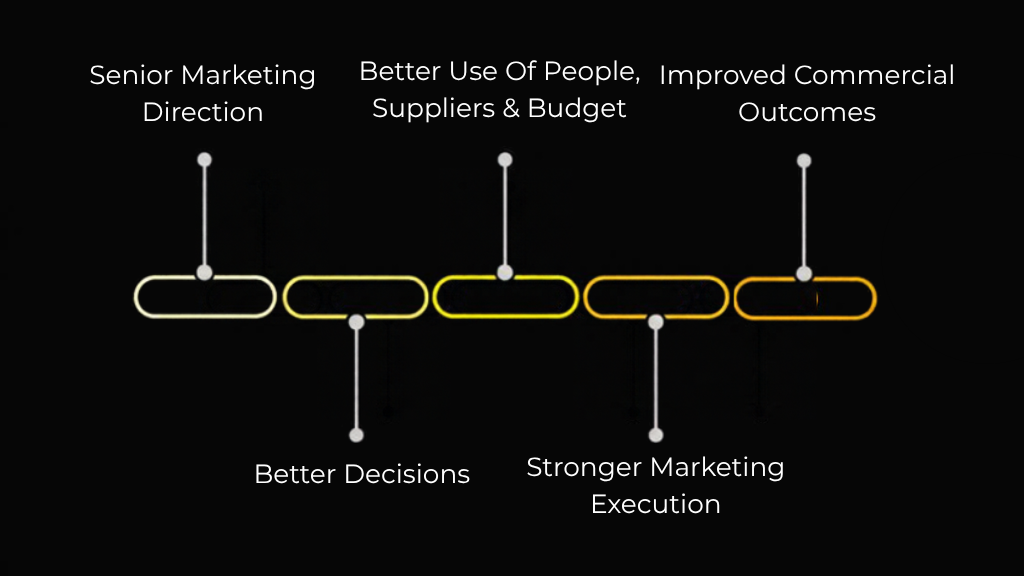
A business might have plenty of marketing activity but still lack clear answers to some basic questions. Who are we trying to reach? What should we be known for? Which channels deserve investment? What should marketing prioritise this quarter? Without clear answers, teams can become reactive. They respond to requests, produce content and launch campaigns without a consistent connection between each activity and the wider business strategy.
A Fractional CMO can bring those decisions together. They can establish priorities, connect marketing activity to commercial goals and give the team a clearer route from strategy through to execution. That can also make things easier for business leaders. They have a clearer view of where marketing is heading, what it needs to achieve and where further investment may be worthwhile.
The distinction between strategic advice and ongoing marketing leadership is also worth considering, particularly when comparing a Fractional CMO with a marketing consultant.
Good direction also makes it easier to say no. When time and budget are limited, every new idea cannot become a priority. Knowing what to leave out can protect the work that matters most.
The strategy should still have room to change. Customer needs, market conditions and business priorities can all shift, so regular review helps keep marketing relevant without losing sight of the wider commercial goal.
What Impact Can They Have On Your Existing Team?
A Fractional CMO doesn’t necessarily need to replace the people already working in marketing. In many businesses, the team needs stronger direction, clearer priorities or additional senior support.
A marketing executive might produce excellent content but lack clarity around which topics deserve attention. A marketing manager might coordinate several suppliers without enough senior oversight. A founder might still make most marketing decisions because nobody else owns the wider direction. Senior support can address those gaps while allowing the existing team to keep doing the work they know best. A Fractional CMO can set priorities, review activity, guide team members, and bring greater accountability to delivery. They can also identify where additional expertise would help, whether that means bringing in a specialist freelancer, changing an agency relationship or giving an existing team member greater ownership.
This can help the people already working within the business spend more of their time on focused work. It can also reduce the amount of senior management time spent dealing with individual marketing decisions. Rather than replacing the existing team, a Fractional CMO can work alongside them, providing senior direction, clearer priorities and practical support where needed. This approach can be particularly useful when a business already has marketing activity in place but needs someone to bring it together, as explained in our guide to what a Fractional CMO actually does.
Businesses rarely have exactly the same marketing gaps. The right level of Fractional CMO support should reflect the people, skills and resources already available.
Can A Fractional CMO Reduce Wasted Marketing Spend?
Marketing waste doesn’t always come from obviously poor campaigns. It can come from overlapping suppliers, unclear responsibilities, underused tools or channels that continue to receive investment without producing enough value.
A Fractional CMO can review these areas together rather than looking at each cost in isolation. That means considering budgets, suppliers, channels, internal resources and the role each one plays within the wider strategy. The review can also uncover costs that have accumulated over time. Businesses often add software, agencies and specialist support as they grow, but those arrangements don’t always receive the same level of scrutiny later.
Reducing unnecessary spending can contribute to Fractional CMO ROI. However, cutting costs for the sake of it can create problems elsewhere. Removing an activity that supports an important commercial outcome may simply shift the cost to another part of the business.
Time can be wasted too. A strong strategy that sits untouched for months has limited value, particularly when the business has already invested time and money in developing it. Practical support can help turn agreed priorities into action.
What Should You Measure?
There is no single metric that can tell you whether a Fractional CMO engagement is working. The measures should reflect what the business actually wants to improve.
Commercial measures will usually sit high on the list. Depending on the business, these might include qualified pipeline, conversion rates, customer acquisition cost, marketing-generated revenue and the value of new opportunities. However, revenue can take time to appear, particularly when a business has a longer sales process. Operational measures can provide useful evidence in the meantime. Campaign delivery, website conversion, supplier performance and progress on priority projects can show whether things are moving forward.
Team performance is worth considering too. Has ownership become clearer? Is the team spending more time on priority work? Does the founder still need to make every significant marketing decision? These changes may not appear in a revenue report, but they can affect how efficiently the business operates.
Marketing spend should also be considered alongside output. If the business spends less while maintaining or improving performance, that can represent a meaningful gain. The same applies when an existing team delivers more because its priorities and responsibilities are clearer.
Establishing a baseline before the engagement starts makes these changes easier to assess. You can compare performance over time rather than relying on whether marketing simply feels more organised. The measures should also reflect changing business needs. A company with strong lead generation but weak conversion may need different indicators from one struggling with direction, delivery or supplier management.
What Could Fractional CMO ROI Look Like In Practice?
A simple example can help put the numbers into context.
Imagine a business invests £30,000 in Fractional CMO support over a year. During that period, the Fractional CMO helps improve the marketing strategy, restructure supplier activity and strengthen the lead-to-sale process. The business then generates an additional £100,000 in gross profit that can reasonably be linked to those improvements.
The initial investment will vary depending on the level of senior expertise, involvement and practical support required. Our guide to Fractional CMO costs in the UK explores the factors that influence pricing and the financial commitment involved.
The ROI calculation would be:
(£100,000 − £30,000) ÷ £30,000 × 100 = 233.33%
That means the business has generated a 233% ROI, or around £2.33 in net return for every £1 invested.
However, the important point is that the £100,000 figure shouldn’t automatically be treated as the result of the Fractional CMO’s work. Other marketing activity, sales performance, market conditions and wider business changes may have contributed to the result.
The example also shows why looking at revenue alone can give a misleading picture. If that £100,000 represented additional revenue rather than gross profit, the actual financial return would depend on the business’s margins and the other costs involved in generating it.
A real assessment should therefore use figures that make sense for the individual business. Understand what changed, what the engagement contributed and what financial return can reasonably be associated with those changes.
How Do You Know What Impact A Fractional CMO Has Had?
Attribution can be one of the harder parts of assessing Fractional CMO ROI. Marketing rarely operates in isolation, and a Fractional CMO may influence several areas at once.
Some results are relatively straightforward to identify. Other effects are harder to separate. A Fractional CMO might improve positioning, clarify the customer proposition, strengthen the marketing team’s processes and introduce a more focused strategy. Those changes can influence results across several channels over time.
It can help to think about the impact in three ways. Direct impact covers changes that can be closely linked to the work, such as reducing costs or improving a measurable conversion point. Influenced impact covers areas where the Fractional CMO contributes to an outcome alongside the wider team, such as pipeline growth or stronger campaign performance. Longer-term impact can include better marketing processes, clearer ownership and a stronger foundation for future growth.
This doesn’t mean every positive change should be attributed to the Fractional CMO. Instead, the business should look at the evidence available and consider what changed after the engagement began, which factors contributed and how confident it can be in the connection.
That makes the baseline particularly important. Without a clear picture of performance before the engagement, it becomes much harder to understand what has actually improved.
When Should You Expect To See A Return?
Fractional CMO ROI rarely appears as one immediate result. Some improvements can happen quickly, while others take time to affect the wider business.
A business may stop unnecessary activity, change a supplier arrangement or clarify its marketing priorities within the first few weeks. Those changes can improve efficiency before they have any visible effect on revenue. Other returns take longer. Improving positioning, building a stronger pipeline or changing how a team works can take several months. Longer B2B sales processes can add further time between a marketing decision and the resulting revenue.
That makes clear priorities and realistic measures important from the beginning. The business should know what needs to change, what success looks like and which indicators should improve first. Progress should then be reviewed regularly. If something isn’t working, there is little value in continuing simply because it appeared in the original strategy. The plan may need to change as the business learns more. Budget could move between channels, a supplier could be replaced, or the internal team could need more support in a particular area. A return should therefore be judged over the life of the engagement rather than by one campaign or one month. The impact may come from a series of improvements that strengthen marketing over time.
Is A Fractional CMO Worth The Investment?
The value of a Fractional CMO depends on what the business needs from its marketing. It also depends on how well the engagement addresses those needs. For some businesses, the biggest opportunity may be improving the commercial direction of marketing. For others, it may mean getting more from an existing team, bringing suppliers together or reducing low-value activity.
If you want to see how this approach works in practice, you can explore our Fractional CMO service. We combine senior marketing direction with practical support, including strategy into delivery, internal team guidance, supplier management and hands-on marketing support where needed.