


Fractional CMO vs full-time CMO becomes an important question as a growing B2B business reaches a new stage. Marketing may need stronger senior leadership, but a permanent CMO can still feel like a significant commitment.
A full-time CMO can take ownership of the marketing function, lead a team and stay closely involved in the business. A Fractional CMO can provide many of the same senior skills without creating a permanent executive role.
The decision therefore goes beyond salary. You need to consider how much leadership your business needs, how much time that person needs to spend with you and who will actually deliver the marketing activity. For some businesses, a permanent senior marketing leader will make sense. For others, the immediate need may be experienced leadership that can work alongside an existing team and adapt as the business develops.
What Is The Difference Between A Fractional CMO And A Full-Time CMO?
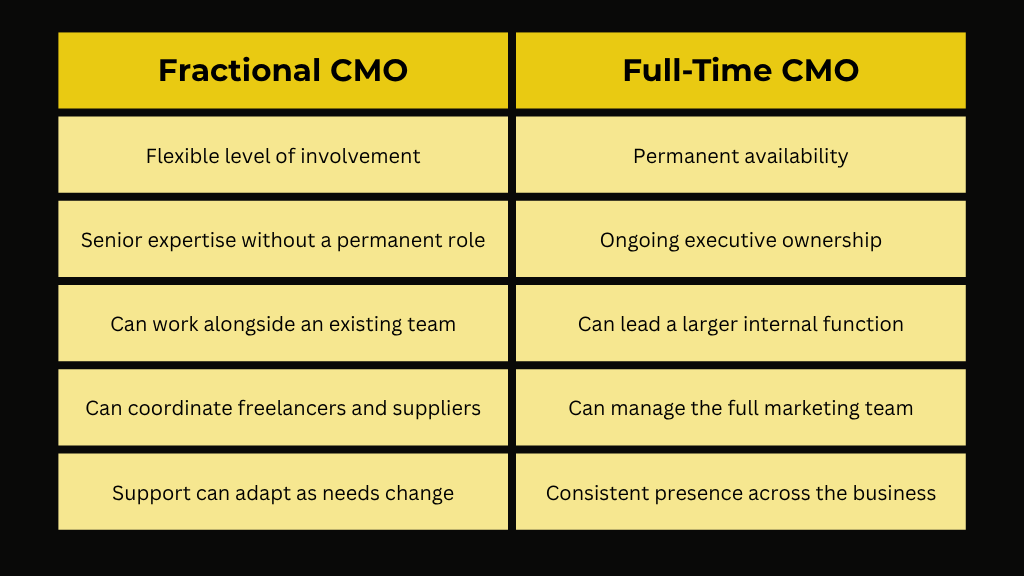
A Fractional CMO provides senior marketing leadership on a part-time or flexible basis. They can help shape strategy, set priorities, review performance and guide the people responsible for marketing. A full-time CMO takes on that responsibility as a permanent member of the leadership team. Their role can cover the full marketing function.
The difference is therefore largely about commitment, capacity and ownership.
A full-time CMO is available as part of the business every working week. They can become deeply embedded in commercial planning, work closely with other senior leaders and take ongoing responsibility for the marketing function. A Fractional CMO provides senior input for an agreed level of involvement. This can range from strategic oversight to more hands-on support, depending on what the business needs.
If flexible senior marketing leadership sounds closer to what your business needs, see how our Fractional Marketing Director support works.
This distinction also matters when comparing a fractional marketing director vs a full-time marketing director. The terminology may vary between businesses, but the underlying question remains the same: does the business need a permanent senior marketing leader, or does it need access to that level of expertise without creating a full-time role?
If you’re still getting to grips with the role itself, our guide to What Is A Fractional CMO? explains how the model works and what a Fractional CMO can provide.
Fractional CMO Vs Full-Time CMO: The Key Differences
The choice becomes clearer when you look at what each model means for the business.
Cost And Financial Commitment
The most obvious difference is the financial commitment.
A full-time CMO creates an ongoing employment cost. The business needs to consider salary, employer costs, benefits, recruitment and the wider cost of maintaining a senior executive role.
A Fractional CMO gives the business more control over how much senior marketing support it buys. You might need a few days each month, or a greater level of involvement during a period of growth or change.
That doesn’t mean fractional support will always cost less. A business that needs full-time leadership may get more value from employing a permanent CMO. The useful comparison is therefore the level of expertise and responsibility the business needs against the commitment required to secure it.
The 2026 CMO Survey highlights another factor businesses need to consider when structuring their marketing function. Its research found that inadequate resourcing was the most commonly cited capability gap. Marketing leaders pointed to a lack of people, time or budget. Marketing headcount growth had also slowed sharply compared with the previous year. For a growing business, this makes resource allocation particularly important. The question isn’t simply whether you can afford a senior marketing leader. It’s whether a permanent role is the right way to use that investment at your current stage.
Understanding Fractional CMO pricing can also help you assess the financial commitment involved and compare it with the cost of employing a full-time CMO.
Capacity And Availability
A full-time CMO offers a level of availability that a fractional arrangement cannot replicate. They can spend their working week inside the business, attend leadership meetings, manage a marketing team and stay close to ongoing commercial decisions. This can be particularly useful when marketing has become a large and complex function.
A Fractional CMO works differently. Their involvement is deliberately limited, which can be an advantage when the business doesn’t need full-time senior marketing attention.
You may have a capable marketing manager who handles day-to-day activity. You may also have freelancers or specialist agencies supporting particular channels. In that situation, the missing piece could simply be senior oversight. The important question is how much leadership your marketing function actually needs. Paying for full-time availability only makes sense if the business has enough responsibility and work to justify it.
Ownership And Accountability
A full-time CMO can take direct ownership of the marketing function. They can lead the team, manage the budget, establish priorities and remain accountable for performance over the long term.
A Fractional CMO can also take significant responsibility, but the exact arrangement needs to be clear. They may lead the strategy while an internal team manages implementation. They may coordinate external suppliers or take responsibility for specific areas of delivery.
This makes ownership particularly important when comparing providers. Before agreeing an engagement, establish who makes the decisions, who manages the people doing the work and who is responsible for reviewing performance. A fractional arrangement can work extremely well when these responsibilities are clear. Without that clarity, the business can end up with senior advice but no clear owner for putting it into practice.
Strategy And Practical Delivery
This is one of the most important differences to consider.
A senior marketing leader should provide strategic direction. They need to understand the business, identify priorities and make decisions about where marketing effort and investment should go. However, strategy only creates value when someone can turn it into action.
Some senior marketing arrangements focus heavily on strategy. The CMO develops the plan, presents recommendations and then relies on an internal team or external suppliers to deliver the work. That can be appropriate when the business already has strong marketing capability. It becomes less useful when the business lacks the people or specialist expertise needed to execute the plan.
This is where the scope of a Fractional CMO engagement matters. Some Fractional CMOs provide primarily strategic advice. Others become much more involved in implementation, team guidance and supplier management. A full-time CMO can also operate at different levels. Some focus mainly on leadership and direction, while others remain closely involved in campaigns, performance and execution. The key is therefore not simply whether someone is fractional or full-time. It’s understanding how they will combine senior decision-making with the practical work required to move the marketing function forward.
This also plays an important role in determining the return on investment from a Fractional CMO, particularly when assessing how leadership translates into measurable marketing results.
How Should You Decide Between A Fractional CMO vs Full-Time CMO?
There isn’t one model that suits every growing B2B business. The right choice depends on the stage of the business, the existing team and the level of responsibility marketing needs to carry.
When Does A Full-Time CMO Make More Sense?
A full-time CMO can make sense when marketing has become a substantial part of the business and needs permanent senior ownership.
This might be the case when:
- Marketing has a sizeable internal team that needs ongoing leadership.
- Marketing is closely involved in wider commercial and leadership decisions.
- The business operates across multiple products, markets or customer groups.
- There is enough ongoing responsibility to justify a permanent senior role.
- The business needs someone available to lead marketing throughout the working week.
- Building a long-term internal marketing function is a priority.
A permanent CMO can become deeply embedded in the organisation. They can build relationships across the leadership team, develop internal capability and take ongoing responsibility for the direction and performance of marketing. For a business at this stage, that continuity can be important.
When Does A Fractional CMO Make More Sense?
A Fractional CMO can make sense when the business needs senior marketing leadership but doesn’t yet need a permanent CMO.
This might be the case when:
- You have marketing activity underway but lack senior direction.
- You have an internal marketing manager who needs experienced leadership.
- You already use freelancers or agencies and need someone to coordinate them.
- You need to establish or review your marketing strategy.
- You are entering a period of growth or change and need additional senior expertise.
- You don’t have enough ongoing responsibility to justify a full-time CMO.
- You need strategic leadership alongside practical marketing support.
This can be particularly useful for SMEs. You don’t necessarily need to replace the marketing resources you already have. Instead, a Fractional CMO can work alongside them, providing senior oversight while helping the existing team focus on the activity they are best placed to deliver.
The arrangement can also change as the business develops. You may initially need more senior involvement while a strategy is established. Later, the focus might shift towards team guidance, supplier management or periodic strategic reviews. That flexibility can be difficult to achieve with a permanent role.
How Digiwoods Approaches Fractional Marketing Leadership
Digiwoods takes a practical approach to the Fractional CMO model.
Traditional Fractional CMO support can focus heavily on strategy. The CMO establishes the direction, identifies priorities and provides senior guidance, while the business then works out how to deliver the plan. That approach can work well when the business already has enough marketing resource. It can be less helpful when the strategy needs to be translated into practical activity and there isn’t enough capacity to do so.
We combine senior marketing thinking with practical support where it’s needed. The work can begin with understanding the business, reviewing the existing marketing function and establishing the priorities that will support its commercial objectives. From there, the support can flex around the business. That might mean guiding an internal marketing manager, coordinating freelancers and specialist suppliers, reviewing campaigns or taking responsibility for particular areas of delivery.
The aim isn’t to replace everything the business already has. Existing people and suppliers can continue doing what they do well, while additional senior expertise fills the gaps around them. This is how our Fractional CMO service is designed to work. The level of support can adapt to the business rather than forcing it into a fixed model. That can be particularly useful when a business needs senior marketing leadership today but doesn’t yet know what its marketing function will look like in two or three years.
Final Thoughts
The fractional CMO vs full time CMO decision ultimately comes down to what your business needs from its senior marketing function.
A full-time CMO provides permanent leadership, availability and ownership. That can suit a business with a substantial marketing function and enough ongoing responsibility to justify a senior executive role. A Fractional CMO provides senior expertise with greater flexibility. This can suit a business that needs stronger direction, leadership or coordination without creating a permanent CMO position.
The decision should also consider what happens after the strategy has been established. Who will manage the team? Coordinate suppliers? Deliver the campaigns? Who will take responsibility for performance? Those questions matter because senior marketing leadership and practical delivery need to work together.
For some businesses, the answer will be a permanent CMO. For others, a Fractional CMO can provide the right level of leadership while the business continues to develop its internal marketing function. And where a business needs both senior direction and practical support, the model can be built around the resources it already has.