


Marketing agency vs Fractional CMO is a common question for B2B businesses deciding how to strengthen their marketing. Both can bring experience, expertise and additional marketing support, but they tend to solve different problems.
A marketing agency will usually be brought in to deliver specific marketing activity, from content and social media to paid advertising, web development and lead generation. A Fractional CMO, meanwhile, typically provides senior marketing leadership, helping a business decide where to focus, how to build a strategy and what needs to change.
So, what does your business actually need? Do you have a marketing problem because there isn’t enough capacity to get the work done, or a marketing leadership problem because nobody is setting the direction? You might even have both. Perhaps you have an internal marketing team, but lack senior direction. Or you might have several freelancers and suppliers already in place, but no one overseeing how everything fits together.
That distinction matters because the right support isn’t necessarily determined by the size of your marketing budget or the number of services you need. It depends on where the biggest gap is within your business and what you already have in place.
Whether you’re deciding between a Fractional CMO or marketing agency, the first step is understanding what your business actually needs.
So, when comparing a marketing agency vs Fractional CMO, which is the better option?
What Is A Marketing Agency?
A marketing agency provides specialist marketing services on behalf of a business. The exact services vary between agencies, but they can include areas such as content marketing, social media, SEO, paid advertising, email marketing, website development, branding and creative work.
For a B2B business, an agency can provide access to a wider team without the cost of employing several specialists internally. Instead of hiring a copywriter, designer, SEO specialist and social media manager separately, for example, an agency can bring those capabilities together.
Agencies can also be useful when there is already a clear plan but not enough time or specialist knowledge to deliver everything internally. A marketing manager might understand the business well but have limited capacity to manage every campaign, create every asset or oversee every channel. An agency can take responsibility for some of that workload while the internal team remains involved.
If you’re specifically comparing a Fractional CMO vs digital marketing agency, the same distinction applies. A digital marketing agency will generally focus on delivering defined digital activity, while a Fractional CMO provides broader senior marketing direction.
The relationship can also vary considerably. Some businesses use an agency for one specific area, such as paid advertising or SEO. Others use one across several channels as an extension of their existing team. The important thing is that an agency gives you access to people who can do the work. The more clearly you can define what that work needs to achieve, the easier it is for an agency to deliver against it.
What Is A Fractional CMO?
A Fractional CMO provides senior marketing leadership without working as a full-time Chief Marketing Officer. During that time, they provide strategic guidance based on their experience.
Their role might involve reviewing the existing marketing function, identifying opportunities and developing a marketing strategy. They can also define priorities, set goals and help senior leaders make better marketing decisions.
For a growing B2B business, this can provide senior expertise that might otherwise prove difficult to justify as a permanent hire. A Fractional CMO can also strengthen an existing marketing function by supporting internal managers and reviewing external suppliers. They can assess performance and establish a clearer plan for the months ahead.
If you’d like to explore the model in more detail, our guide to What Is A Fractional CMO? explains what the role involves and how it can support a growing business.
You may also come across the term Fractional Marketing Director, which is sometimes used interchangeably with Fractional CMO. If you’re comparing a Fractional Marketing Director vs marketing agency, the same question applies: do you need senior marketing leadership, additional delivery capacity, or a combination of both?
Traditional Fractional CMO support tends to focus primarily on senior marketing direction. That can be particularly valuable when marketing has become difficult to manage, priorities keep changing, or senior leaders aren’t confident that their current activity is moving the business forward.
The Fractional CMO may work with the people already responsible for marketing, helping them understand what needs attention and how different activities should connect. Depending on the arrangement, however, the business may still need separate resources to carry out the work.
Marketing Agency Vs Fractional CMO: The Key Differences
The simplest way to think about the difference is this:
A Fractional CMO is generally focused on deciding what the business should do and why. A marketing agency is generally focused on delivering the work.
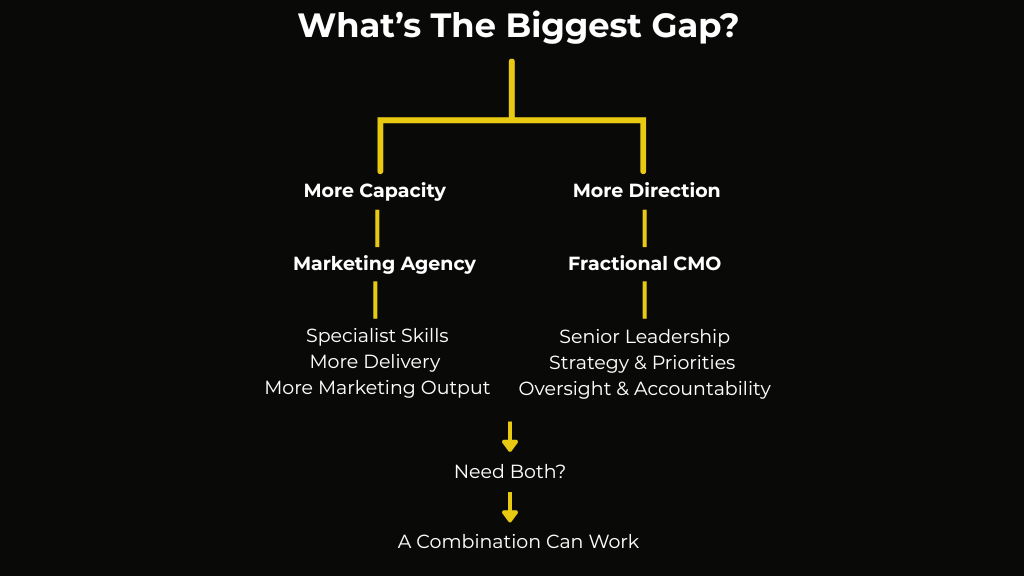
When considering Fractional CMO vs an agency, however, the distinction isn’t only about strategy and execution. There are several practical differences worth considering before making a decision.
Senior Marketing Direction
A business brings in a Fractional CMO at a senior level. Their role often involves looking across the wider business. They determine how marketing should support its commercial objectives. This could involve identifying target audiences, refining positioning, reviewing the customer journey or setting marketing priorities. They may also decide where the business should allocate its marketing budget.
An agency can provide strategic input too, particularly when experienced senior marketers work on the account. However, the business usually engages the agency for specific services and marketing activities. The agency then focuses its work around those agreed areas.
The key question is how much senior marketing involvement your business needs. If your team already makes marketing decisions confidently, an agency may provide enough additional expertise. If those decisions prove more difficult, your business may need more senior support. A Fractional CMO can provide that experience when nobody internally has enough senior marketing expertise.
Execution And Delivery
This is where the distinction becomes particularly practical.
An agency usually has a team ready to carry out marketing activity. Once objectives and priorities are agreed, it can create content and manage campaigns. It can also develop a website, run social media or provide specialist services you’ve commissioned.
A Fractional CMO isn’t necessarily responsible for delivering those activities personally. Their time may be better spent on planning, decision making and performance reviews. They can also support the people responsible for implementation and help keep activity aligned with wider priorities.
That doesn’t make one model better than the other. It means the business needs to understand where the actual work will sit. A Fractional CMO can work effectively alongside an existing team or supplier network. An agency can also take on a greater share of the day-to-day workload.
Accountability
Accountability can also look quite different between the two models.
A Fractional CMO may be responsible for marketing leadership, strategic decisions and performance direction. They can help establish objectives and monitor progress, but the actual delivery may sit across several people or suppliers.
With an agency, accountability often centres more closely on the work being delivered. For example, an agency managing your content, social media and paid campaigns takes responsibility for those activities. It should deliver them to an agreed standard.
Neither model automatically solves accountability, though. The business still needs clear objectives, defined responsibilities and agreed measures of success. Without these, a Fractional CMO may make recommendations that nobody acts on. An agency may also deliver plenty of activity without connecting it clearly to commercial goals.
Cost
Cost is another important consideration, but you shouldn’t simply compare a Fractional CMO’s day rate with an agency’s monthly fee. Instead, consider what you get for your investment and what additional resources the business needs around that support.
Gartner’s 2026 CMO research highlights the pressure marketing leaders are facing to deliver growth with constrained resources. Marketing budgets increased by just 1.3% from 2025, while Gartner reports that CMOs are facing rising expectations alongside limited budget growth.
For a B2B business, choosing between internal resource, external specialists and senior marketing expertise can make a significant difference. A Fractional CMO provides senior expertise without the cost of employing a full-time CMO. An agency can also give you access to a wider range of specialists through a monthly retainer or project fee.
However, the headline cost doesn’t tell the whole story. A business working with a Fractional CMO may need to budget separately for implementation. An agency may require more internal time for direction, approvals, business knowledge and decision-making. If you’re looking at the financial side in more detail, our guide to Fractional CMO costs in the UK (link to Fractional CMO Cost UK: The Complete Guide To Pricing) explores the factors that can affect pricing, including the level of support and involvement required.
The most cost effective option gives the business the right balance of expertise, capacity and ownership. Paying less for the wrong type of support won’t necessarily deliver better value.
Internal Resource
Your existing team should play a major role in the decision.
Consider what your people are already responsible for, where their time is going and what they can realistically take on. An experienced marketing manager may benefit from additional senior input, while a smaller team may simply need more hands on support.
The same applies to external suppliers. If you already have freelancers, agencies or specialists working on different parts of your marketing, bringing in another provider without considering how everything fits together could create more complexity.
Before choosing either model, it is worth taking an honest look at your current setup. You may need more people, more specialist knowledge, clearer ownership or better coordination. Identifying that first will make the decision much easier.
When Is A Marketing Agency The Better Fit?
A marketing agency is often the stronger choice when you know what marketing activity needs to happen and need additional people or specialist expertise to deliver it.
Agencies work well if:
- You know which marketing services you need.
- Your internal team doesn’t have enough capacity.
- You need access to several marketing specialisms.
- You want ongoing support with marketing activity.
- You already have clear positioning and target audiences.
- You need help delivering campaigns consistently.
- You have internal people who can provide business knowledge and approvals.
For example, a B2B company might know that it needs to improve its LinkedIn presence, create more useful content, strengthen its website and generate more enquiries. If the priorities are already clear, an agency can take responsibility for turning them into consistent activity.
An agency can also be useful when you want to keep your existing marketing structure but increase what it can achieve. Your marketing manager might remain the main point of contact, while the agency provides the additional people and specialist skills needed to move projects forward.
In these circumstances, the value comes from helping the business get more done without building a larger marketing department internally.
When Does A Fractional CMO Make More Sense?
A Fractional CMO can be a better option when marketing needs stronger senior oversight or when your team lacks the experience to make important decisions confidently.
This might be the case if:
- You don’t have a senior marketing leader internally.
- Your marketing activity feels disconnected.
- You aren’t sure where your budget should be going.
- You need a clearer marketing strategy.
- Your positioning or messaging needs reviewing.
- You have an internal marketing team that would benefit from senior guidance.
- You already use freelancers or agencies but need someone to coordinate the bigger picture.
- You want experienced marketing leadership without hiring a full time CMO.
For example, a growing B2B business might have a marketing manager, a web developer and several freelancers. Everyone stays busy, but senior decisions around positioning, priorities, budget and performance lack consistency. A Fractional CMO can bring the experience and oversight needed to give the function greater structure.
This support can also help when a business enters a new stage of growth. Marketing decisions that worked when the company was smaller may no longer fit. Senior input can help the business identify what needs to change and where to focus next.
The business should also consider how the team will deliver those priorities. A Fractional CMO can work with existing teams or external suppliers. However, the business needs enough resource to deliver the agreed work effectively.
What If You Need Both Strategy And Execution?
Many B2B businesses don’t fit neatly into one category.
You may already have marketing activity underway but need someone to bring greater structure to it. You may have a strong internal understanding of the business but need specialist support with particular activities. Maybe you also need more senior input for a period while you establish a new marketing function or approach. In these situations, it can be useful to think about the combination of support you need, rather than choosing a label first.
A Fractional CMO can work alongside an existing agency or internal team. An agency can provide strategic input as well as delivery. Or you can work with a partner that can establish the direction and then provide practical support where required. This flexibility can be particularly valuable for SMEs because you don’t need to replace everything you already have. Your internal marketing manager can remain in place. Existing freelancers can continue working, and specialist agencies can stay involved where they add value.
Instead, you can build external support around the gaps in your current setup. This might include reviewing performance each month, prioritising activity, coordinating suppliers or taking responsibility for specific pieces of work. The potential value of this approach is explored further in our guide to Fractional CMO ROI (link to Fractional CMO ROI: How Much Value Can You Really Gain?), which looks at how better direction, resource allocation and execution can contribute to the return from senior marketing support.
This is where an approach that combines senior marketing direction with practical delivery can be particularly useful. Rather than handing a strategy back to the business and expecting the team to work out how to deliver it, the right partner can help establish the priorities, coordinate the people involved and support implementation where needed.
That’s the approach Digiwoods takes, working alongside internal teams, freelancers and other suppliers while stepping into delivery when the business needs additional support. You can find out more about the Fractional CMO service and how this approach works for growing B2B businesses. We create a marketing function that works as a whole, rather than adding another layer that the business then has to manage.
Final Thoughts
There isn’t a universal winner when comparing a marketing agency vs Fractional CMO. The right choice depends on where your business currently has a gap and what you already have in place.
When you need additional marketing capacity and specialist expertise, an agency could be the right fit. Senior marketing leadership and greater oversight may point towards a Fractional CMO. More complex setups may benefit from a combination of internal and external support.
The important thing is to look at what your marketing function actually needs before deciding which type of provider to hire. Consider who is making the decisions, who is doing the work, who is responsible for performance and whether those roles are working together effectively.
The best marketing support fits your business as it stands today while giving you enough flexibility to adapt as it grows. Some businesses will benefit most from an agency, while others need a Fractional CMO. A combination of strategic direction and practical support may suit businesses with more varied needs.