


Fractional CMO vs marketing consultant is a debate many B2B businesses face when they know their marketing needs to improve but aren’t sure whether they need specialist advice, ongoing leadership or a combination of the two.
You might have a specific marketing problem that needs experienced input. You might want someone to review your current approach and identify what should change. Or you might already have people working on marketing but need someone senior enough to guide them, make decisions and take a more active role in the overall direction of the function. All three situations can call for external support, but they don’t necessarily call for the same type of support.
A marketing consultant can bring valuable expertise to a defined challenge, project or decision. A Fractional CMO can become more involved in the wider business, helping shape priorities, guide the people involved and stay accountable for keeping marketing moving in the right direction. The question is therefore less about which title sounds better and more about how much involvement your business actually needs.
What Is A Marketing Consultant?
A marketing consultant is typically brought in because a business needs external expertise, an independent perspective or help solving a particular marketing challenge. That could involve reviewing an existing marketing strategy, identifying weaknesses in lead generation, advising on positioning, assessing a particular channel or helping your team plan a new campaign. The scope can vary significantly. Some consultants specialise in a particular area, while others provide broader strategic advice. Some work with businesses for a single project, while others remain available for ongoing consultancy.
The important point is that a consultant’s involvement is usually shaped around the expertise or advice the business needs. For example, imagine you’ve been investing in LinkedIn but aren’t seeing the level of engagement or commercial opportunities you expected. You might bring in a consultant to assess your activity, identify what’s holding it back and recommend a better approach. If you already have someone internally who can take those recommendations and put them into practice, that may be exactly the support you need. You don’t necessarily need another person involved in every marketing decision. You may simply need someone experienced to help you make a better one.
What Is A Fractional CMO?
A Fractional CMO provides senior marketing leadership to a business on a part time or flexible basis. The role can cover strategy, priorities, decision making, team guidance, supplier management, performance reviews and practical delivery, depending on what the business actually needs. If you want a fuller explanation of the role itself, our guide to what a Fractional CMO is goes into more detail.
For this comparison, the important distinction is the level of involvement. A Fractional CMO is generally brought into the wider marketing function rather than being asked to solve one isolated problem. They can look across the different parts of your marketing, understand how they fit together and help determine what deserves attention next. That could mean working with an existing marketing executive, coordinating freelancers, reviewing an agency’s work or helping the leadership team decide where marketing budget should be allocated.
You may also see the role described as a Fractional Marketing Director. When considering fractional marketing director vs marketing consultant, the same question applies: are you looking for specialist advice, or do you need someone who can become more involved in leading the marketing function over time?
Fractional CMO Vs Marketing Consultant: The Real Difference
There is considerable overlap between the two roles. A good marketing consultant can provide strategic advice, work closely with a client and even become involved in implementation. A Fractional CMO can also provide advice and practical support. Either can have extensive experience, so the difference isn’t necessarily about capability or seniority.
It’s more useful to look at the relationship and scope of the work. A consultant is often brought in to help answer a question, solve a problem or provide specialist expertise, whereas a Fractional CMO is more likely to become part of the ongoing decision making around marketing.
The distinction can be summarised like this:
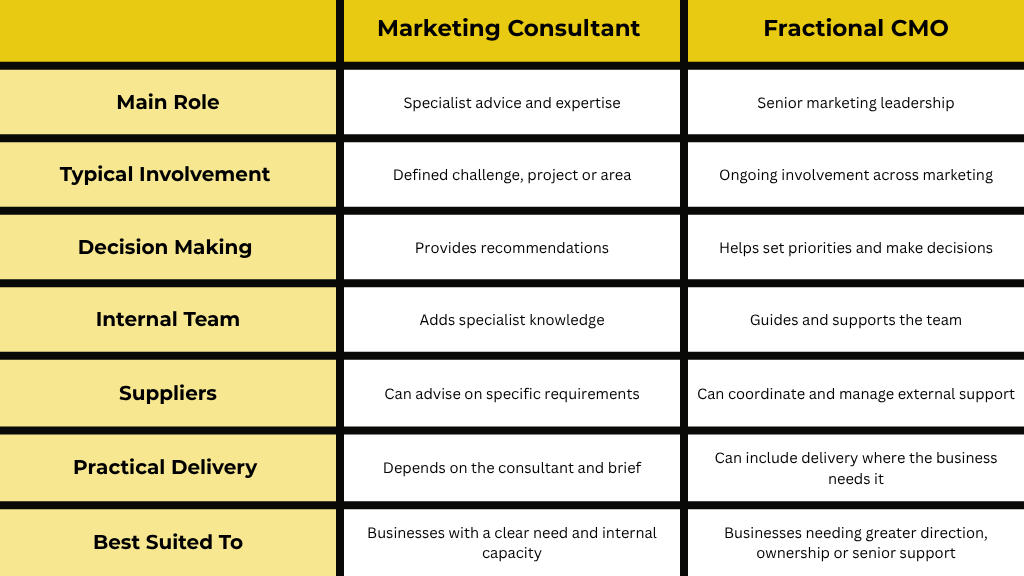
These aren’t hard and fast rules. A consultant might work with a business for several months, while a Fractional CMO could become closely involved in a specific project. What really matters is what you need that person to take responsibility for. That’s often more useful than focusing on the length of the contract or everything listed in the job description.
A Defined Problem Or An Ongoing Challenge?
If you know exactly where you need help, consultancy can be a sensible choice. Perhaps your website isn’t converting, your positioning isn’t clear, your content isn’t reaching the right people or your lead generation process needs reviewing. You can bring in someone with the right expertise, get an independent assessment and use their recommendations to address the problem.
The situation changes when the problem isn’t isolated. Your website, content, LinkedIn activity and lead generation may all need attention, but you may not know which should come first. You may also have several people contributing to marketing without anyone deciding how their work should fit together. In that situation, you may not need another recommendation. You may need someone who can continually assess the situation, make decisions and keep the marketing function moving.
Advice Or Ownership?
This is one of the most useful distinctions to consider when comparing the two. A consultant can help you understand:
What should we do differently?
A Fractional CMO can help answer that question while remaining involved as the business decides what happens next. That doesn’t mean a consultant will simply hand you a report and disappear. Many consultants work closely with clients and provide ongoing support. The difference is the degree to which you want the external specialist involved in the continuing leadership of marketing.
If your business has the internal capability to take advice, make decisions and manage implementation, consultancy may be enough. If you want someone senior to help shape priorities and challenge decisions, a Fractional CMO may provide greater value. They can also guide your team and help maintain momentum.
Specialist Input Or A Wider View?
A consultant can be particularly valuable when you need expertise that you don’t currently have. For example, you may have a strong general marketing team but need specialist knowledge of SEO, brand positioning or a particular marketing channel. A consultant can fill that gap without becoming responsible for the wider marketing function.
A Fractional CMO is more likely to look at how the different pieces connect. They might ask whether your positioning supports the sales process. Your content may also need to reflect the priorities of the business. Another consideration is whether your marketing team is spending time on the right activities. External suppliers may also need reviewing to determine whether their work is delivering enough value. That wider perspective becomes increasingly useful when marketing involves several people, channels and suppliers.
Project Support Or Continuity?
Consultancy can work particularly well when you have a clear beginning and end point. You might want a strategy reviewed, a new campaign planned or a specific marketing problem investigated. Once the work is complete, your internal team can take over.
A Fractional CMO relationship is usually more continuous. They can stay close enough to the business to understand what has changed, review what is working, challenge what isn’t and help decide what should happen next. That continuity can be valuable because marketing decisions rarely exist in isolation. A change in sales priorities can affect marketing, a new competitor can change your positioning, and a new member of the team can change what you are capable of delivering. A campaign that underperforms can also mean your original assumptions need revisiting. Having someone who understands the wider picture makes it easier to respond to those changes.
Do You Need Advice Or Ongoing Ownership?
If you’re unsure which model you need, start by asking what you expect the person to do after they’ve given you their initial recommendations.
If your answer is:
“We’ll take it from there.”
A marketing consultant may be the better fit. You have the people, leadership and capacity to turn advice into action. What you’re missing is specialist knowledge or an outside perspective.
If your answer is:
“We need someone to help us decide what happens next.”
A Fractional CMO may make more sense. You might already have people doing the work, but what’s missing may be someone senior enough to prioritise that work, challenge decisions, connect the different activities and keep everyone focused on the same commercial objectives. This distinction is particularly important for B2B SMEs because having a marketing team doesn’t automatically mean having marketing leadership. Recent MarketingCharts research found that 59% of CMOs are experiencing increased pressure from CEOs to prove marketing’s value, highlighting why accountability and clear performance measurement matter at senior level.
When Is A Marketing Consultant The Better Fit?
A marketing consultant could be the right choice if your business has a defined need and enough internal capability to act on the advice. You might benefit from consultancy if:
- You need an independent review of your marketing
- You have a specific marketing problem to solve
- You need specialist expertise that isn’t available internally
- You’re planning a particular project or campaign
- You want an outside perspective before making a significant decision
- Your internal team already has clear senior leadership
- You need temporary expertise rather than ongoing marketing leadership
For example, if your marketing manager has identified a weakness in your positioning but wants an experienced specialist to review it before making changes, bringing in a consultant could be a very effective use of external support. The business gets the expertise it needs without adding another ongoing layer of management.
When Does A Fractional CMO Make More Sense?
A Fractional CMO becomes more relevant when the challenge goes beyond one area of marketing. You may have plenty of activity but no clear sense of what matters most. Perhaps you have an internal marketer who needs senior guidance. You might also work with several freelancers or agencies without anyone overseeing their work as a whole. Alternatively, you may be making all the marketing decisions yourself and no longer have the time or experience to manage them effectively.
In some cases, the next consideration is whether you need flexible senior support or a permanent leadership role. Our guide to Fractional CMO vs full-time CMO (link to Fractional CMO Vs Full Time CMO: Which Is Right For Your Business?) explores how the two models differ in terms of availability, accountability and financial commitment.
In those situations, you need someone who can help make the right decisions, guide the people involved and keep those decisions connected to the wider business. A Fractional CMO can make sense if:
- Your marketing needs clearer senior direction
- Your internal team needs someone experienced to guide them
- You want to get more value from the people already working in marketing
- Several suppliers or freelancers need coordinating
- Marketing activity feels busy but disconnected
- You want someone involved in ongoing prioritisation and decision-making
- You need greater accountability around marketing
- You’re not ready to hire a full-time Marketing Director or CMO
The common thread is that you need more than an answer to a marketing question. You need someone who can help lead what happens afterwards, while providing practical support where that’s what the business needs.
What If You Already Have A Marketing Team?
This is one of the most important questions to ask before assuming you need more marketing resource. You might already have a marketing executive or junior marketer who is doing a good job. They may manage campaigns, create content, update the website and keep your marketing activity moving. However, they may not have the experience to determine whether all that activity is actually the right activity.
That doesn’t mean they’re doing a bad job. It simply reflects the difference between delivering marketing activity and leading the wider marketing function. This becomes particularly important when marketing decisions need to connect back to wider commercial objectives.
This is where a Fractional CMO can add a different type of value. Rather than replacing the person you already have, they can provide senior guidance around them. They can help set priorities, review output, provide direction and make sure the team focuses on work that supports the wider business.
The same applies when you already work with freelancers or external suppliers. You don’t necessarily need to replace them. You may simply need someone senior enough to decide what they should be doing and assess whether their work delivers value. They can also make sure everyone’s activity fits into one coherent marketing plan. That can help you get considerably more from the resources you already have.
Making better use of existing people and suppliers can also contribute to the return on investment from a Fractional CMO (link to Fractional CMO ROI: Is It Actually Worth The Investment?), particularly when senior leadership helps improve performance without significantly increasing marketing resources.
What If You Need Flexible Support?
Not every business needs the same level of involvement from an external marketing specialist, and those needs can change over time. You might initially need strategic advice on a particular challenge, then need someone to guide an internal team later, or eventually need practical help getting the plan delivered. Thinking about the role in terms of what the business needs rather than what the job title promises can therefore be more useful than trying to fit your situation into a fixed definition.
That flexibility also means you don’t necessarily have to choose between senior strategy and practical delivery. A business may need someone to establish the direction, then help the existing team, freelancers or suppliers turn that direction into action. In other cases, the main requirement may be senior oversight, with the internal team handling most of the implementation.
Our Fractional CMO service is designed around that principle. The role can work alongside the people you already have, including junior marketers, executives, freelancers and external suppliers. It can focus heavily on senior direction when that is the main gap, while also providing practical delivery where additional support is needed.
That flexibility is particularly useful for businesses that know they need more from marketing but aren’t necessarily looking to build a larger internal team.
Final Thoughts
The decision between a Fractional CMO vs marketing consultant becomes much easier when you look at the role you actually need someone to play. If you have a defined problem, need specialist expertise and have the internal capability to turn recommendations into action, a marketing consultant could be the right choice.
If your marketing needs ongoing senior direction, your existing team needs guidance, or you want someone more closely involved in deciding what happens next, a Fractional CMO may be a better fit. The simplest question to ask is:
Do you need someone to advise your marketing, or do you need someone to help lead it?
If the answer is advice, a consultant may give you exactly the expertise you need. If the answer is leadership, direction and continued involvement, a Fractional CMO may be the better fit. The right choice comes down to the gap in your business today and the level of senior involvement needed to close it.