


It is easy to use LinkedIn for a while without giving much thought to anything beyond likes, comments, or the occasional connection request. Then, usually when you start trying to make sense of your visibility or performance on the platform, you come across something called the LinkedIn SSI score.
It often appears when you are looking more closely at your profile activity or trying to understand how effective your presence really is. Suddenly there’s a score out of 100, a breakdown of categories, and a term like “Social Selling Index” that sounds more important than it actually is in practice.
Once you dig into it, you realise it’s LinkedIn’s way of measuring how actively you are using the platform in line with its idea of social selling. While it can be a useful guide, it doesn’t fully reflect the real impact of how you use the platform. This blog outlines what the LinkedIn SSI score is, how it works, and whether it actually matters for your LinkedIn presence and results.
What is the SSI score on LinkedIn?
Once you see the SSI score on LinkedIn for the first time, it tends to raise the same set of questions. What exactly is being measured, where does the number come from, and is it something you should actually care about?
It’s a metric that feels precise but becomes less rigid once you understand what it represents. In simple terms, the LinkedIn SSI score is LinkedIn’s Social Selling Index. It’s a score out of 100 that reflects how actively you’re using the platform in ways LinkedIn considers aligned with effective professional networking and relationship building.
You can view your own score through LinkedIn’s official SSI dashboard here: LinkedIn Social Selling Index (SSI). LinkedIn describes the Social Selling Index as a way of measuring how effectively professionals perform in four main areas. Those areas are: establishing their brand, finding the right people, engaging with insights, and building relationships on the platform. Each area contributes to your overall score and gives a snapshot of how your activity lines up with LinkedIn’s definition of social selling.
It’s worth stepping back here. The score can look precise, but it’s still only a reflection of behaviour on the platform. It does not measure influence, trust, or business outcomes, which are often what people actually care about. In other words, it measures activity, not authority.
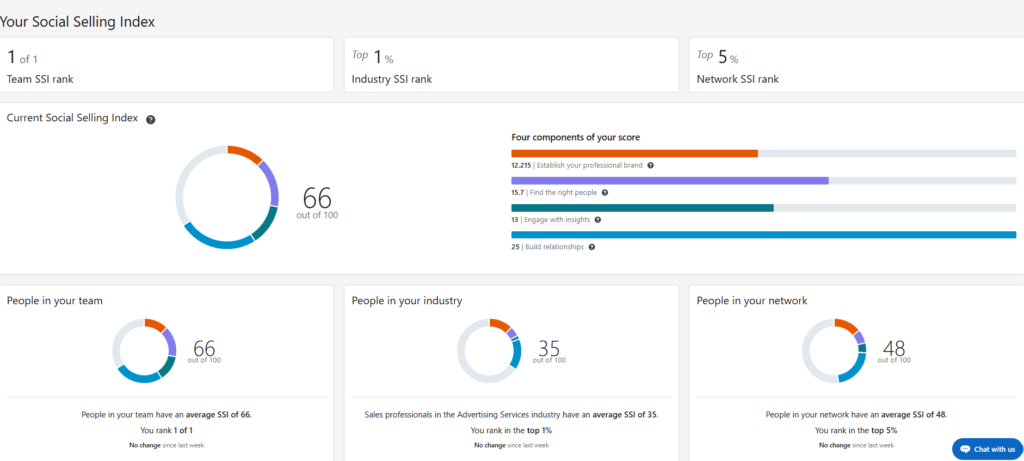
How The SSI Score Is Calculated
The SSI score is built around behaviours LinkedIn already encourages across the platform. LinkedIn doesn’t publish the exact weighting behind the score, but the direction is clear. It rewards consistent activity, relevant networking, and meaningful engagement.
This includes posting regularly, connecting with people in your industry or adjacent spaces, engaging with other users’ content, and building relationships over time rather than simply increasing connection numbers.
What’s interesting is that none of this is especially new or surprising. The score does not introduce a strategy. It simply quantifies behaviours that already define a strong LinkedIn presence.
In that sense, it is less of a performance system and more of a mirror. A mirror can be useful, but it doesn’t tell you where to go next.
Do You Need Sales Navigator To Access It?
There is often confusion around whether the SSI score is tied to Sales Navigator.
The simple answer is no. You can access your SSI LinkedIn score with any standard LinkedIn account through the public SSI dashboard. Sales Navigator does include more advanced sales and prospecting features, but the SSI score itself is not locked behind a paid subscription.
How To Increase LinkedIn SSI Score In A Meaningful Way
If you start looking at how to increase your LinkedIn SSI score, it is easy to become focused on the number itself. The irony is that people who achieve the strongest scores are rarely thinking about the score at all. Instead, they are simply using LinkedIn consistently and engaging with the platform in a meaningful way.
Building the right network is an important part of that process. However, growing connections strategically matters more than simply sending as many requests as possible. Understanding LinkedIn’s connection request limits can help you expand your network while protecting your account health.
Regular posting is a good place to start improving your score. It helps keep you visible and shows LinkedIn that you are an active participant in the conversations happening on the platform. That doesn’t mean posting every day or constantly creating content. Consistency matters far more than volume.
Your network also plays an important role. Many people focus on growing their connection count, but the real value comes from building a network that reflects the people, industries, and discussions that are genuinely relevant to you. A smaller network of engaged, relevant connections will usually be far more valuable than a large network with little meaningful interaction.
Perhaps the most overlooked factor is engagement. The people who tend to get the most from LinkedIn are not just publishing content and moving on. They are commenting, responding, sharing opinions, and taking part in conversations. Those interactions help build visibility, but more importantly, they help build relationships. This is often where the biggest opportunities emerge. While posting content helps people see you, engaging with others gives them a reason to remember you.
For professionals using LinkedIn specifically for sales and business development, tools such as Sales Navigator can also support the process of finding relevant prospects and building targeted relationships.
For a more structured approach, you can explore our LinkedIn upskilling services, which focus on building a clear plan for how your team uses LinkedIn.
Why The LinkedIn SSI Score Is Not The Full Picture
The SSI LinkedIn score can be useful, but only in context.
A higher score does not automatically translate into more leads, better conversations, or stronger business outcomes. It simply reflects how closely your activity aligns with LinkedIn’s preferred behaviours.
It’s also possible for someone with a lower score to outperform someone with a higher one if they’re more intentional about content, positioning, and relationship building.
This is why the SSI score works better as a reflection tool than a success metric. It shows activity, but it does not show impact. And those two things are not always aligned.
Final Thoughts
The LinkedIn SSI score can be a useful indicator of how actively you are using the platform, but it’s only one piece of a much bigger picture. While it can highlight areas where you could be more visible or engaged, it can’t tell you whether you’re building meaningful relationships, starting valuable conversations, or creating opportunities that lead somewhere.
That’s why it makes sense to treat the score as a guide rather than a goal. The people who get the most from LinkedIn don’t chase metrics. They show up consistently, share useful insights, engage with others, and build genuine connections over time. Those behaviours drive a strong SSI score, but more importantly, they create long-term value.
For businesses looking to turn these activities into a more structured approach, our complete LinkedIn marketing guide helps you align content, engagement and relationship building with wider business goals.