


Many B2B businesses reach a point where marketing starts to become more complex. Campaigns are running, teams are producing content, sales teams are asking for more support, and marketing activity spans multiple channels. Without a clear strategy connecting it all, it becomes difficult to see what is actually driving growth. This is often when business owners start asking what is a fractional CMO, and whether senior marketing guidance could help bring more structure to their activity.
A common assumption is that the answer is simply doing more marketing. More content, more campaigns, and more channels can seem like the obvious next step. But if there’s no clear direction behind those activities, increasing output doesn’t always lead to better results. For some businesses, hiring a full-time CMO is the right move. For others, the timing, cost, and commitment of a permanent senior hire may not make sense yet. This is where a fractional CMO service can provide a flexible alternative.
Understanding the fractional CMO meaning helps explain why this approach has become increasingly popular with growing B2B businesses. It provides access to senior marketing experience and strategic support without requiring a full-time hire.
In this guide, we’ll break down what a fractional CMO is and what they do day-to-day. We’ll also look at fractional CMO cost structures and when this type of support makes sense for a business.
What Is A Fractional CMO?
A fractional CMO is a Chief Marketing Officer who works with a business on a part-time or flexible basis rather than being employed full-time.
In simple terms, a B2B fractional CMO gives growing businesses access to senior marketing knowledge without needing to make a permanent hire.
The role sits between strategy and execution. A fractional CMO isn’t there to replace an existing marketing team or provide occasional advice. Instead, they help businesses understand where to focus, what to prioritise, and how marketing activity connects back to wider business goals.
Unlike a consultant who may primarily provide specialist advice, a Fractional CMO takes an active role in shaping priorities, guiding marketing activity and helping the business make decisions. The level of involvement can vary, but the role is generally focused on providing ongoing senior marketing leadership rather than occasional input.
Not every fractional CMO model works in the same way. Some focus mainly on strategy, planning, and senior guidance, leaving the internal team or external suppliers to handle delivery. My approach is slightly different. I see fractional CMO support as a blend of strategy and execution where needed, helping set the direction while contributing to delivery when required.
The role of senior marketing leadership has evolved significantly in recent years, with CMOs increasingly expected to influence wider business decisions rather than focus only on campaign activity. Harvard Business Review has explored how the CMO role continues to evolve as businesses place greater importance on strategy, customer insight, and growth.
For example, a business might already have a marketing manager, external partners, and campaigns running, but still feel unsure about whether those activities are working together effectively. A fractional CMO can help bring structure and clarity to those decisions.
This is particularly useful for businesses that have reached a stage where marketing is important for growth, but the internal structure has not yet caught up.
What Does A Fractional CMO Actually Do?
A fractional CMO typically works across four interconnected areas that move marketing from planning to performance:
- Creating a marketing strategy that supports business goals
- Leading and aligning teams around clear priorities
- Supporting execution through campaigns, processes, reporting, and partner coordination where needed
- Connecting marketing activity to measurable business growth
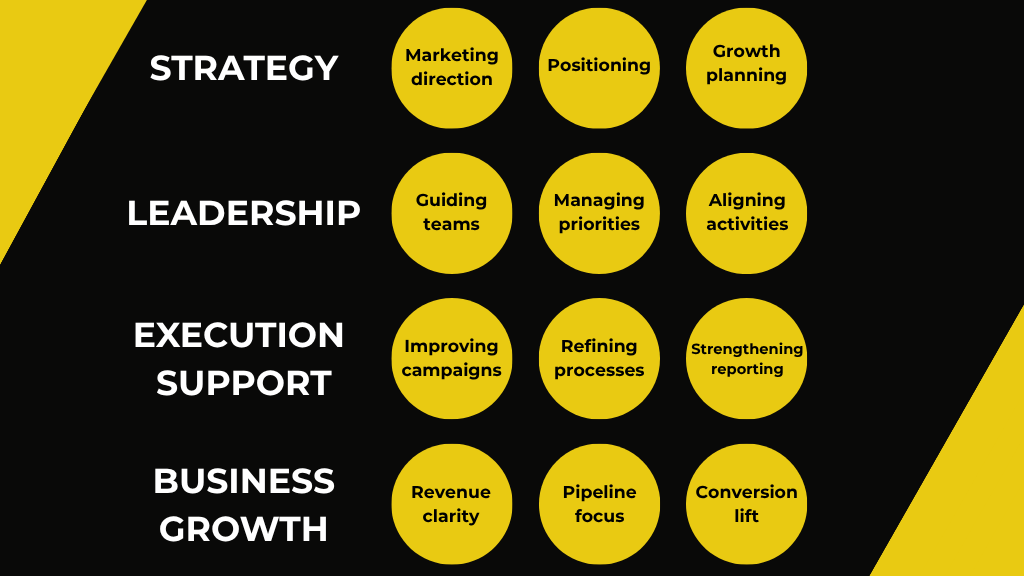
The role is often less about creating more work and more about making existing activity more effective.
This is where the balance matters. A strategy-only fractional CMO may help define the plan, but the business still needs people to turn that plan into visible marketing activity. In my view, the stronger model is one where strategy leads the work, but execution is still supported properly through the right mix of internal effort, direct involvement, and external partners.
For example, a business may have content being produced, paid campaigns running, and a sales team asking for more leads. However, without someone looking at the bigger picture, these areas can become disconnected.
A fractional CMO helps bring these pieces together by ensuring marketing activity is focused on the right priorities, aligned with wider business goals and supported by the people responsible for delivery.
Understanding how that activity can translate into measurable value is an important part of the role, particularly when leadership needs to assess whether the investment is contributing to wider business goals (link to Fractional CMO ROI: How Much Value Can You Really Gain?).
When Does A Business Need One?
A fractional CMO is usually most valuable when a business already has marketing activity happening but needs more structure around it.
This often happens when:
- Marketing is becoming harder to manage as the business grows
- Teams are focused on delivery but lack senior guidance
- Leadership wants more confidence in marketing decisions
- A full-time CMO feels like too big a commitment at the current stage
- Marketing decisions are becoming increasingly reactive rather than guided by a clear plan
In many cases, the issue isn’t that teams aren’t working hard enough. Most businesses already have people creating content, managing campaigns, and keeping things moving.
The challenge is making sure those activities are working towards the same objectives. A fractional CMO helps provide that direction while giving the business flexibility as priorities change.
For businesses considering whether fractional leadership or a permanent senior marketing role is more appropriate, factors such as business stage, existing resources and the level of responsibility required can all influence the decision. The difference between these approaches is explored in more detail in Fractional CMO Vs Full Time CMO: Which Is Right For Your Business?.
Fractional CMO Vs Marketing Manager Vs Agency
These roles can sometimes appear similar, but they support businesses in different ways.
A marketing manager is usually focused on delivering and managing day-to-day marketing activity. An agency typically provides specialist expertise and additional delivery across areas such as SEO, paid media, content or design. A fractional CMO takes a broader view, helping shape marketing direction, connect activity with business goals and align internal teams and external partners.
Businesses may also use these roles together. A fractional CMO can provide senior direction while a marketing manager handles day-to-day activity and specialist agencies or freelancers provide additional expertise or delivery. The right structure depends on the gaps within the existing marketing function.
Where a business needs to understand the difference between strategic leadership and specialist external delivery, the Marketing Agency vs Fractional CMO | Which Is Better for B2B? comparison explores how the two models can support different needs.
The same consideration can apply when a business is weighing up a Fractional CMO against a marketing consultant (link to Fractional CMO vs Marketing Consultant | When Is Each the Better Fit?), particularly when it needs to decide between specialist advice and broader, ongoing marketing leadership.
How Much Does A Fractional CMO Cost?
The cost of a fractional CMO varies depending on experience, involvement, business complexity and the level of responsibility required. Rather than having one fixed price, engagements can be structured around the amount and type of support a business needs.
Common approaches include:
- Day rate engagements for defined strategic input or advisory support
- Monthly retainers covering ongoing leadership and marketing oversight
- Hybrid models that adjust involvement based on business priorities
The right structure will depend on factors such as how embedded the Fractional CMO needs to be, the complexity of the marketing function and whether the role is primarily strategic or includes practical support.
For businesses considering the cost of this type of support, Fractional CMO Cost UK: The Complete Guide To Pricing looks at how experience, involvement and responsibility can affect pricing.
For many B2B businesses, the appeal sits less in the specific rate and more in the flexibility, allowing them to bring in senior marketing leadership when needed without committing to the fixed overhead of a full-time hire.
Final Thoughts
A fractional CMO gives growing businesses a practical way to bring more experience, structure, and clarity into their marketing. By introducing senior-level guidance at the right stage of growth, businesses can make more informed decisions about where to focus their efforts and how to build a stronger marketing function.
For businesses that have started to outgrow ad hoc marketing but are not quite ready for a full-time CMO, this approach can provide the support needed to make better decisions and build a stronger marketing foundation.
The businesses that benefit most are often the ones looking for a clearer direction and a stronger connection between marketing efforts and business growth.