


Brand guidelines are the foundation of consistent marketing. They define how a brand looks, sounds and behaves across every channel, from digital campaigns to everyday content. Brand guidelines development is the process of creating a clear and practical system that defines how a brand looks, sounds and behaves, ensuring consistency across all marketing activity.
Yet in practice, many brand guidelines fail to support the work they are meant to guide. It’s common to see documents that run to dozens of pages, filled with detail that’s difficult to apply in fast-moving environments.
The challenge isn’t a lack of guidance, but how usable that guidance is in day-to-day work. When brand guidelines are difficult to access or interpret, teams often rely on judgement instead of a shared system, which can lead to inconsistency over time.
Brand guidelines development therefore benefits from a more practical approach. The focus should be on creating something clear, usable and easy to apply in real marketing situations.
Why Traditional Brand Guidelines Often Fail
Traditional brand guidelines often struggle because they are designed as reference documents rather than working tools. They tend to be long, highly detailed and difficult to navigate. While this may feel comprehensive, it slows down usability and makes quick decision-making harder.
Another issue is that they are rarely maintained. Once created, they often sit unchanged while the brand continues to evolve through real-world activity. This creates a disconnect between what is documented and what is actually happening.
When guidance is hard to access or interpret, teams naturally fall back on instinct. Over time, this leads to inconsistent visuals, tone and messaging. In most cases, when guidelines are not being used, the issue is not with the team. It is with the system itself.
What Effective Brand Guidelines Development Should Achieve
Effective brand guidelines development focuses on enabling action rather than documenting every possible rule. A strong system gives teams clarity, removes ambiguity and helps them move faster without second-guessing decisions. When done well, brand guidelines act less like a static manual and more like a practical framework, forming a key part of a broader brand and design approach.
This is particularly important in fast-moving marketing environments where content is produced across multiple platforms at speed. Teams need guidance that supports momentum, not something that slows them down.
If you are looking to close the gap between brand strategy and day-to-day marketing output, practical brand strategy services can help turn your positioning, messaging and visuals into something your team can use consistently.
Why Simplicity Improves Brand Adoption
Simplicity directly influences whether brand guidelines are used in practice. When information is easy to understand and access, it naturally becomes part of everyday workflows. Teams can quickly find what they need and apply it without disruption.
Reducing complexity also removes hesitation. Instead of interpreting long explanations, teams can focus on producing work that aligns with the brand. This leads to stronger consistency across channels, not through enforcement, but through ease of use.
What To Include In Practical Brand Guidelines
Practical brand guidelines should focus only on what is essential for day-to-day marketing. This typically includes core visual identity elements such as logo usage, colour palette and typography, along with tone of voice and messaging principles.
Real-world examples are also important. They help translate rules into application and reduce interpretation gaps across teams. For additional context on brand consistency in modern marketing, this overview from HubSpot provides useful insight.
How To Build Brand Guidelines People Actually Use
Creating usable brand guidelines starts with understanding how people interact with them in real situations. Most users are not reading documents line by line. They are looking for quick answers while working under time pressure. This means structure and accessibility are critical.
Guidelines should be organised around real outputs such as social content, presentations and web pages. This makes them easier to apply in practice. It is also important to focus on what truly matters. Including too much detail can reduce clarity and make the system harder to use.
A simple, structured approach like the example below makes brand guidelines easier to understand and apply in practice.
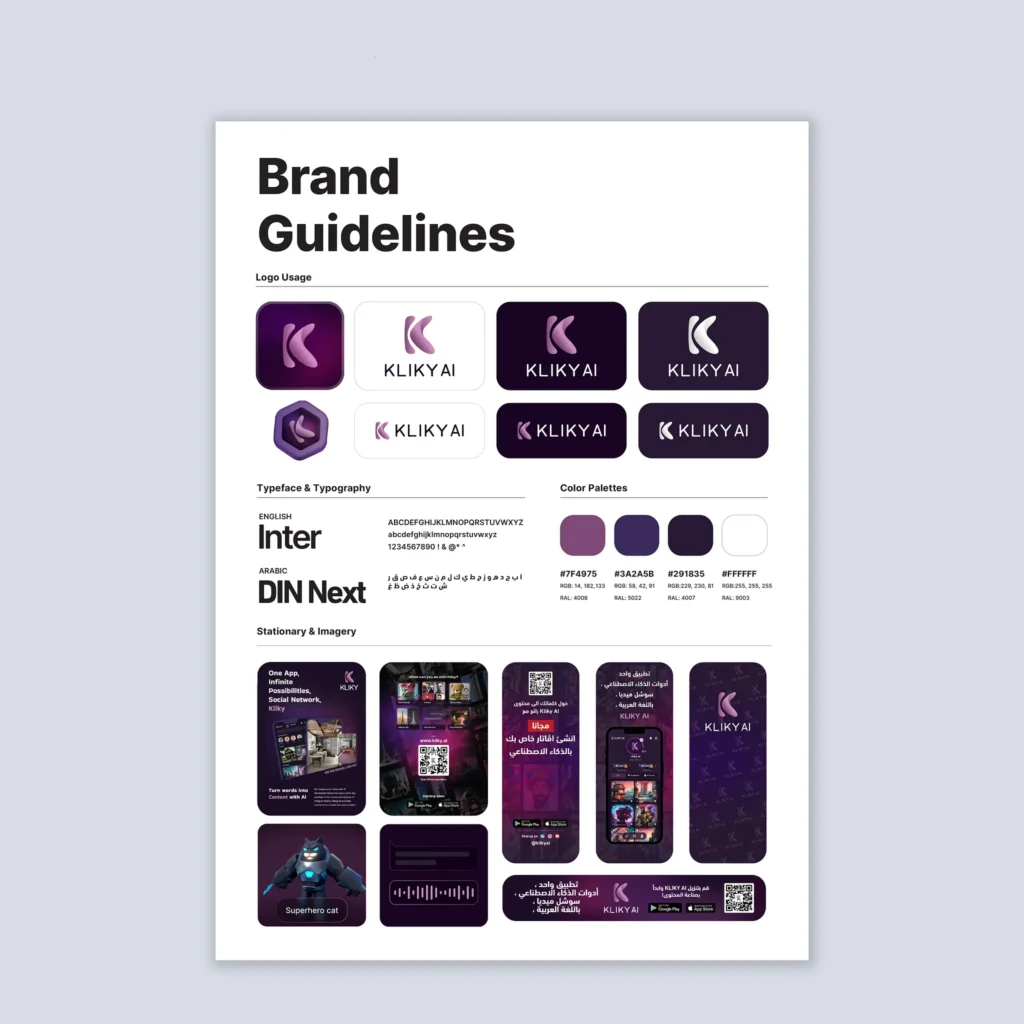
Image by Nihal Graphics on Dribbble – dribbble.com
Brand Guidelines Development Across Different Business Sizes
Brand guidelines development varies depending on organisational size, but usability remains the key factor in every case. Larger organisations often require more structured systems to support multiple teams and stakeholders. However, these systems still need to be easy to navigate and apply. Smaller organisations benefit from simpler frameworks that allow speed and flexibility without unnecessary complexity.
In both cases, effectiveness depends on adoption. A simple system used consistently is far more valuable than a complex document people ignore.
Final Thoughts
Brand guidelines development works best when it prioritises clarity, usability and real-world application.
The goal is not to create an exhaustive document, but to build a system that supports consistent decision-making across everyday marketing activity. Simple, well-structured guidelines are easier to adopt, easier to maintain and more effective in strengthening brand consistency over time.