


Many businesses publish website content regularly, but not all of them take time to plan it properly. Over time, this leads to content that feels a little disconnected.
Content can still perform without a strict plan or SEO tools in place. That said, having a clear approach in the background makes it easier to stay on track, support your audience and build long term visibility.
This guide explains how to plan website content in a simple and practical way.
Why Planning Website Content Matters
Without a clear plan, website content often ends up feeling reactive. One piece might focus on a service, another on an industry topic, and another might sit on the site without a clearly defined purpose.
Over time, this can make it harder for a visitor to understand what the website is really trying to communicate.
When thinking about how to plan website content, the focus is on giving each piece of content a defined role so it contributes to a connected overall direction.
This becomes more important when more than one person creates content.
Start With What Your Audience Actually Needs
Good content planning always starts with people, not tools or keywords.
It helps to focus on the questions people are asking before they make a decision. This usually comes down to what they are trying to solve, what they need to feel more confident, and what might be holding them back from taking the next step.
It can help to picture someone landing on your site for the first time. They are not thinking in terms of pages or structure. They are usually just trying to understand whether they are in the right place.
When content reflects that mindset, it feels more relevant without needing to over-explain itself. It also tends to hold attention for longer because it mirrors real intent.
Building A Simple Content Structure
Once you’re clear on what your audience needs, the next step is to shape your content into something that is easy to maintain and expand.
Most websites do not need anything overly complex. In fact, simpler structures tend to hold up better over time.
A straightforward way to approach this is through three main types of content.
- Services content explains what you offer and how it helps
- Educational content answers questions and builds understanding
- Trust content shows real examples and proof of experience
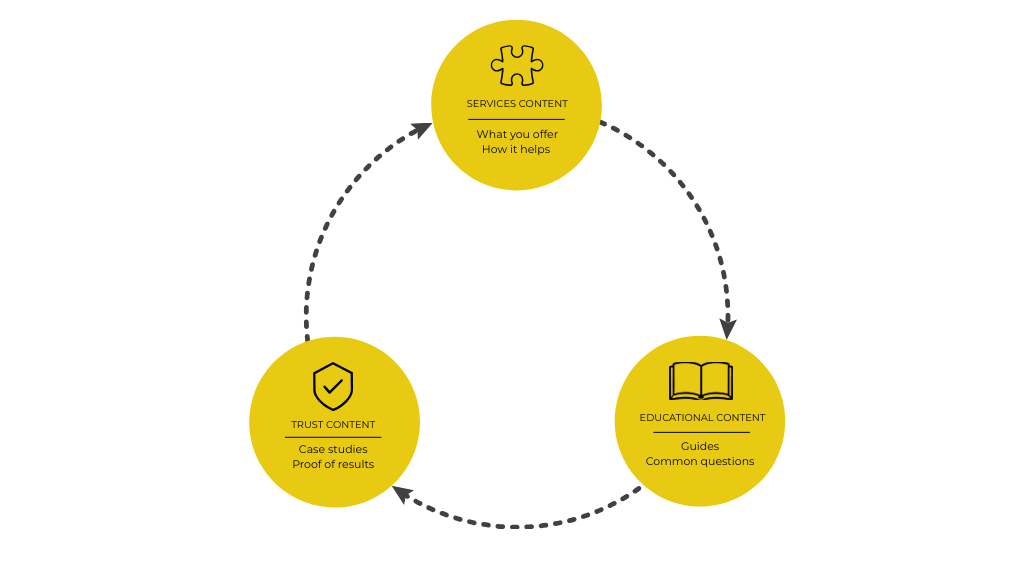
In practice, this might look like a service page supported by blog content that answers related questions, along with case studies that reinforce credibility. Each part supports the others rather than existing separately.
In some cases, this is where strategic website content support can help bring consistency to how a website is organised.
This structure helps create a natural flow through the website, making it easier for people to move from understanding a service to trusting it.
How To Plan Content Without An SEO Tool
It is absolutely possible to plan website content without using SEO tools.
In the early stages, consistency and relevance matter more than data. If content is built around real customer questions and genuine experience, it will naturally begin to align with how people search over time.
A useful starting point is to think about the questions that come up most often in conversations with customers or during enquiries. These tend to form the strongest foundations for content because they come directly from real needs.
For anyone working out how to plan your website content, starting with real customer language is often more effective than relying on external tools too early.
This also helps avoid creating content that is technically optimised but does not feel particularly useful or grounded.
When SEO Tools Become Useful
Before paying for advanced tools, it is worth looking at what you already have access to. Google Search Console can show which searches your website is already appearing for, which pages are getting impressions, and which terms are actually earning clicks. This is useful because it gives you real data from your own website, not just estimated keyword demand.
Google Keyword Planner can also be a useful free alternative for basic keyword research. It is designed for Google Ads, so it should not be treated as a perfect SEO tool, but it can still help you spot search themes, compare keyword demand, and build a starting list of topics.
Once the basics are in place, tools like Semrush or Ahrefs can help identify gaps, highlight keyword opportunities, analyse competitors, and support decisions about what to focus on next.
Ahrefs also provides helpful educational resources around keyword research and content planning, which can be useful when refining an existing approach.
Used well, these tools support refinement rather than direction. They work best when there is already a clear idea of what the content is trying to achieve, what the website already ranks for, and how the site works together.
Repurposing Website Content Across Channels
A well planned piece of website content rarely needs to stay in one place.
Once created, it can be reused across different channels such as email, social media, sales conversations and internal onboarding material. For example, a guide can be broken into shorter pieces for email or social posts.
This is where planning starts to show its value, because each piece of content continues to work beyond its original purpose.
There is also a useful overview of content repurposing approaches available through HubSpot’s marketing resources, which explains how content can be adapted across different channels.
Final Thoughts
Planning website content is about creating enough structure so that everything you publish has a clear purpose and fits into a wider direction.
Your website needs content that explains what you do, answers common questions, and provides proof that builds trust.
When these pieces work together, your website becomes easier to understand, easier to manage and more useful for the people visiting it.