


If your business is growing, you’ve probably started to think more seriously about how your brand is perceived. Not just how it looks, but what it stands for, who it is for and why customers choose you over another option. You’re thinking about B2B brand positioning.
For many small businesses, brand strategy is often made more complicated than it needs to be. Long documents, layered frameworks and abstract theory can take over and in many cases end up unused. The reality is simpler. When your positioning is clear, your team speaks in a consistent way, your marketing becomes easier to manage and your customers clearly understand what you offer.
In this blog, we’ll break down what B2B brand positioning really means, how it connects to your brand guidelines and how to approach it in a practical, usable way.
What Is B2B Brand Positioning?
B2B brand positioning defines how customers understand your business in relation to competitors and the wider market.
It defines who you help, what you do and what makes you meaningfully different from others in your space. The aim is clarity that makes your value instantly recognisable to the right people.
In simple terms, your positioning answers three core questions: who is this for, what problem does it solve and why should someone choose you. When this is clear, people understand what you do faster and with less explanation. That clarity carries through everything else.
Why B2B Brand Positioning Matters For Small Businesses
For small businesses, clarity is more valuable than complexity. Without it, different people tend to describe the business in different ways, which leads to inconsistency in marketing and confusion in sales conversations. Customers are then left trying to interpret your offer themselves, which slows everything down.
Most brand confusion does not come from a lack of ideas, but from too many versions of the same message.
Strong B2B brand positioning helps create consistency across marketing and sales, speeds up internal decision making and makes it easier for customers to understand your value quickly. It also reduces the need to constantly reframe how you explain what you do.
The Link Between Brand Positioning And Brand Guidelines
Brand positioning is the thinking behind your brand. Brand identity is the expression of that thinking. Brand guidelines are the system that keeps everything consistent over time.
If positioning is the decision, identity is the expression and guidelines are what hold everything together in practice. Many businesses reverse this order. They create guidelines before clearly defining positioning, which often results in documentation that looks complete but is difficult to use day to day.
When positioning comes first, everything becomes more usable. Guidelines shift from static documents into practical tools that guide how your brand appears across real-world touchpoints.
This is why many businesses now move towards a more focused approach to brand strategy and brand guidelines development, where clarity comes before structure rather than after it.
If you are reviewing your current setup, it is worth starting with positioning before refining documentation. That foundation makes every other decision easier and more consistent. In simple terms, brand positioning shapes everything that follows.
B2B Brand Identity: Bringing Your Positioning To Life
Your brand identity is how your positioning becomes visible in practice. This includes visual elements such as colour, typography and imagery, as well as verbal elements like tone of voice and messaging style.
When positioning is clear, identity decisions become more deliberate. Design and language choices prioritise how the business should be understood, over personal preference.
This is what creates consistency across every touchpoint. Consistency then builds recognition, and recognition builds trust over time.
Building A Brand Strategy For Small Businesses
In practice, brand strategy is built on a clear positioning foundation:
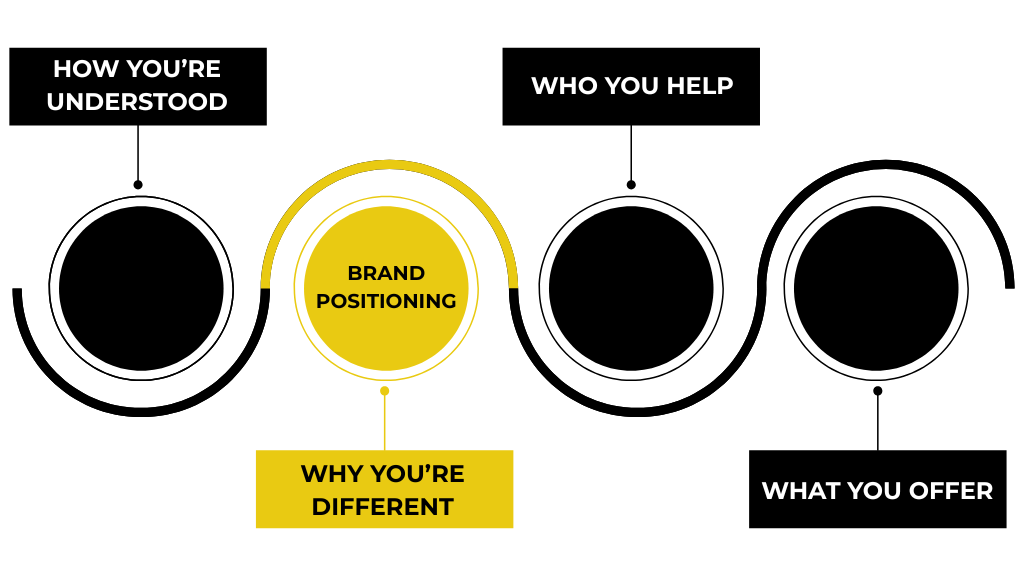
A brand strategy for small business does not need to be complex to be effective. People are much more likely to use simpler approaches in practice.
Instead of producing long documentation, focus on the essentials:
- Who you help
- What you do
- What makes you different
- How you communicate
These form the foundation of positioning. Everything else should support these decisions.
This approach reflects how strategy and marketing favour clarity and consistency over over-detailed frameworks that rarely get used. Publications such as Harvard Business Review have repeatedly highlighted the importance of focus and consistency in building strong brands.
Aligning Your Team Around Your Brand
One of the most practical benefits of clear positioning is alignment.
When everyone in your business understands the brand in the same way, communication becomes more consistent across marketing, sales and leadership. This means fewer mixed messages and smoother execution across teams. Without that shared understanding, teams naturally interpret the brand differently, which leads to friction and unnecessary rework over time.
Strong positioning removes that ambiguity. It creates a shared reference point that keeps everyone working in the same direction.
Final Thoughts
B2B brand positioning creates clarity people can actually use, instead of relying on complex frameworks or overthinking definitions.
When your positioning is clear, everything else becomes easier. It strengthens your identity, sharpens your messaging and aligns your internal teams and marketing around a stable, shared foundation.
Getting this right is often the difference between a brand that feels consistent and one that needs constant explanation.