


Many consider offline marketing outdated, expensive, or hard to measure, but when used with intent, it remains a powerful part of any marketing mix.
As digital channels become noisier and more competitive, many businesses are rediscovering offline marketing as a way to stand out, reach people differently, and support their online efforts. The key is understanding what offline marketing actually is, where it works best, and how to connect it back to measurable outcomes.
This guide breaks down what offline marketing means today, shares practical examples, and explains how online and offline marketing can work together rather than compete.
Contents
- What Is Offline Marketing?
- Examples That Still Work Today
- Offline Marketing Channels Worth Considering
- Online and Offline Marketing Work Better Together
- A Practical Cost Comparison of Offline Marketing in the UK
- How to Track Offline Marketing Without Guessing
- Why Offline Marketing Is Being Reconsidered
- Final Thoughts
What Is Offline Marketing?
Offline marketing refers to any marketing activity that doesn’t happen on the internet. That includes physical, broadcast, or in-person channels that reach people in the real world rather than through a screen.
Common channels include print advertising, billboards, radio, events, sponsorships, and direct mail. While these methods pre-date digital marketing, they haven’t stopped being effective. They’ve just become easier to misuse if they aren’t planned properly.
Examples That Still Work Today
Offline marketing is everywhere once you start looking for it.
Think of a fitness brand choosing to advertise inside local gyms where their exact target audience is already present and engaged. Or a B2B consultancy placing a smartly timed print ad near a conference venue filled with decision-makers. A billboard placed along a commuter route used by legal or financial professionals is another effective example.
These aren’t random placements. They are strategic offline efforts built around context and timing.
For B2B businesses especially, offline marketing is most powerful when your audience already has a reason to be in a specific place. Trade shows, industry events, or physical locations tied to a profession offer concentrated access to the right people.
The difference between effective offline marketing and wasted spend comes down to relevance. When your message appears in a space that already matters to your ideal customer, it becomes far more impactful.
Offline Marketing Channels Worth Considering
Offline channels vary significantly in both cost and complexity, but each has its place when used strategically.
Print advertising can include trade journals, event programmes or local business magazines, particularly when your audience is already engaging with them. Outdoor advertising spans everything from roadside billboards to shopfront displays positioned near relevant venues or business areas.
Radio can still be effective, especially when it is local and aligned with your target audience’s routine. Events and sponsorships offer something digital channels cannot replicate: real, in-person exposure and brand interaction.
There is no single best offline channel. The right option depends entirely on who you want to reach and where they already spend their time.
Online and Offline Marketing Work Better Together
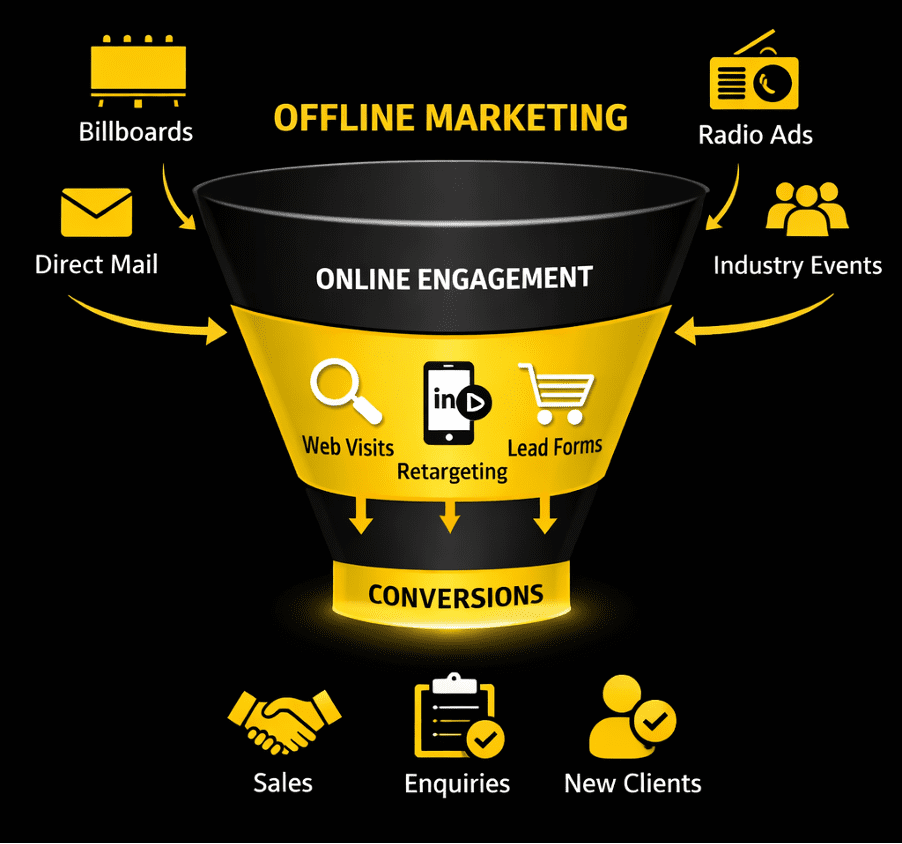
Offline can work for B2B, but it’s less forgiving. Someone might notice a print ad, hear a radio message, or pass a billboard. Later, they search for the brand, visit the website, or engage online.
Campaigns fail when either side is neglected. Offline activity without a digital follow-up fades quickly. Digital campaigns without any real-world presence often struggle to stand out.
A good marketing strategy should focus on how channels support each other rather than running in isolation.
For example, a business may run small-format print and outdoor placements around major industry conferences, then support that exposure with paid search and LinkedIn retargeting in the weeks that follow. The offline activity builds recognition first. The digital follow-up captures intent when people are ready to act.
A Practical Cost Comparison of Offline Marketing in the UK
Offline marketing costs in the UK vary depending on format, placement, and duration, but having realistic benchmarks helps avoid guesswork before budget is committed.
Billboards placed near busy commuter routes or major events can range from a few hundred pounds per week for local placements to several thousand pounds for premium locations. Trade publications aimed at niche professional audiences often charge several thousand pounds per issue, depending on circulation and positioning. Direct mail campaigns typically cost a few pounds per recipient once printing and postage are factored in, making them more effective when sent to warm or well-qualified lists.
Radio advertising costs vary by region and time slot, with local stations often offering more accessible entry points for smaller businesses. Event sponsorships and physical presence at industry exhibitions can be more expensive, but they offer concentrated exposure to highly relevant audiences.
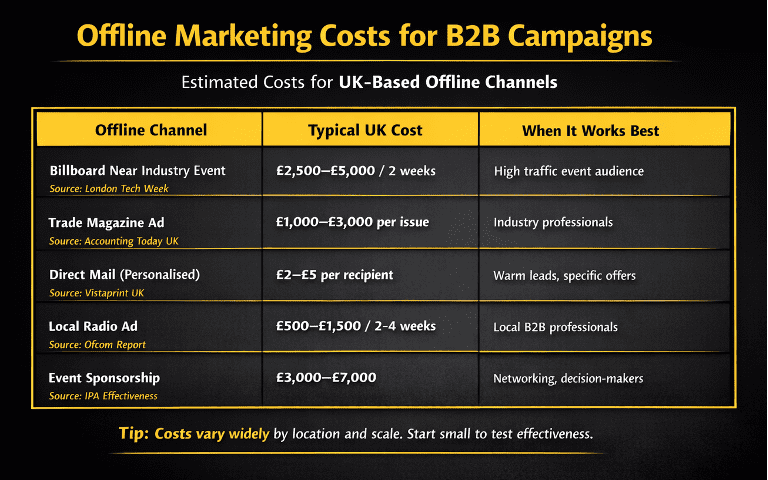
What matters most is not the channel itself, but how tightly it aligns with your audience and objectives. The table above shows a side-by-side comparison of typical costs in the UK, helping illustrate where different channels make sense depending on scale and intent.
For further context on UK pricing, resources such as Accountancy Today UK or JCDecaux UK’s official advertising page can offer a starting point.
How to Track Offline Marketing Without Guessing
Tracking is the biggest challenge with offline marketing, but it isn’t impossible.
Unique offers, dedicated landing pages, QR codes, or specific phrases in a campaign can all help show where interest comes from. Asking new leads how they heard about you still works. You don’t need perfect attribution. You need enough clarity to know whether something is pulling its weight.
Why Offline Marketing Is Being Reconsidered
Many businesses now default to digital. That’s understandable, but it also means competition for attention online is intense, crowded, and increasingly expensive.
Offline channels, by contrast, are quieter. Fewer brands are competing for physical attention, which means well-placed activity can stand out more clearly and, in some cases, costs less than expected. This shift is driven by changing market conditions: rising digital ad costs, platform saturation, and diminishing marginal returns from purely online campaigns.
For example, a B2B firm placing a window advert or outdoor placement near a major industry event may pay less than running a sustained Google Ads campaign, while reaching a highly relevant audience at the exact moment they’re thinking about solutions. The impact comes from reduced noise, not broader reach.
The opportunity isn’t about going backwards, but utilising underused channels strategically to complement digital marketing.
Offline doesn’t make sense for every situation, though; early-stage businesses or brands without a clearly defined audience often struggle to use it effectively because relevance, not visibility, is what makes it work.
Final Thoughts
Offline marketing still has a place. Not everywhere, not for every business, and not without thought.
It works best when it’s targeted, measurable, and connected to online activity. For B2B businesses, planning matters more than budget.
If you’re considering how offline could support your wider marketing strategy efforts, or how online and offline can work together in a practical way, get in touch today.
We help businesses build marketing strategies that make sense in the real world as well as online.