


LinkedIn is a powerful tool for small B2B businesses, but it’s not your company page doing the heavy lifting. It’s your personal profile. When used consistently and strategically, your posts can build real visibility and trust over time. In this article, we’ll share practical LinkedIn post ideas and a repeatable structure to help you show up with clarity, not just when inspiration strikes.
Contents
- Why LinkedIn Content Ideas Work Better on Personal Pages Than Company Pages
- Giving LinkedIn Content Ideas a Clear Shape From the Start
- B2B LinkedIn Post Ideas That Build Long-Term Value
- Turning Content Pillars into Practical LinkedIn Content Ideas
- Example: A Contrarian LinkedIn Post That Sparks Discussion
- What Examples of Good LinkedIn Posts Have in Common
- Turning LinkedIn Post Ideas Into a Repeatable Plan
- Building a Personal LinkedIn Presence That Lasts
Why LinkedIn Content Ideas Work Better on Personal Pages Than Company Pages
On LinkedIn, personal profiles benefit from stronger organic reach, higher engagement, and a sense of familiarity you just can’t get with a company page. When someone comments on a post from a person, it feels like a conversation. From a company page, it can feel more transactional.
For smaller businesses without large paid budgets, this makes a huge difference. A well-run personal page can quietly build trust, warm up prospects, and reinforce credibility long before anyone even talks about a sale. Over time, this often leads to better quality inbound conversations and shorter sales cycles.
That’s why we often recommend treating personal pages as part of a wider LinkedIn marketing strategy, not an afterthought. When personal content and company content support each other, the impact multiplies rather than competes.
This approach aligns closely with how LinkedIn defines meaningful engagement: consistent, relevant contributions that spark conversation rather than broadcast messages.
Giving LinkedIn Content Ideas a Clear Shape From the Start
One of the most common problems we see is people deciding what to post on the day, which usually leads to inconsistency, overthinking, or long gaps with no posts at all.
The goal is to build something repeatable.
Having a simple framework removes the daily stress of “What should I post today?” Instead, you select from a few themes that reflect who you are, what you know, and what you believe. This makes consistency far easier to maintain, even during busy periods.
This is where content pillars come in, a concept we explore in more depth in our content themes and pillars guide.
B2B LinkedIn Post Ideas That Build Long-Term Value
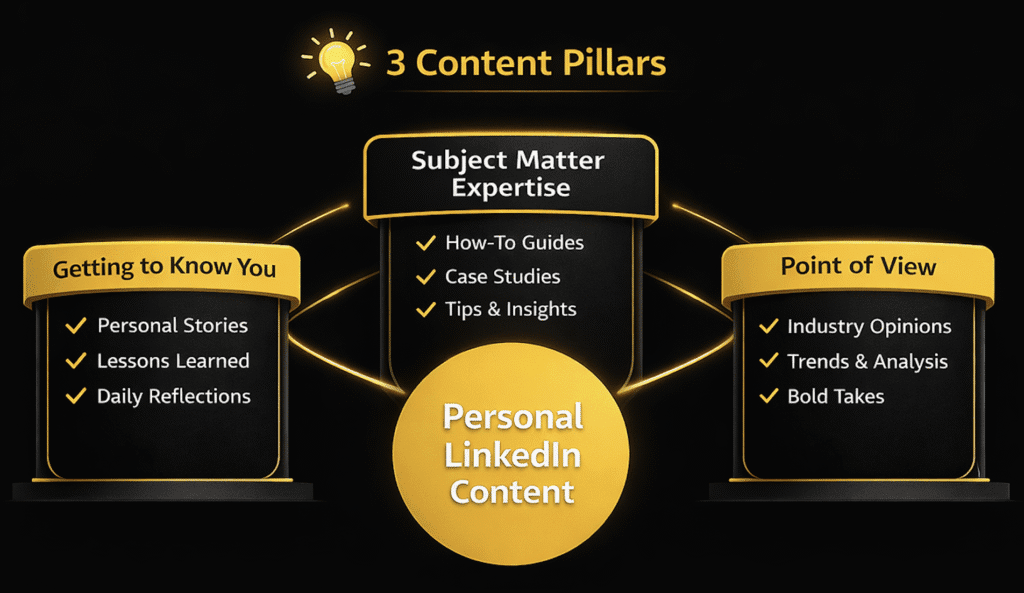
For B2B businesses, personal LinkedIn content works best when it balances credibility with personality. One practical way to achieve this is by building content around a small number of repeatable themes, often referred to as content pillars.
These pillars are not rigid rules. You can have more than three if it suits your business. Their value lies in giving you clear anchors you can return to, week after week, without starting from scratch.
Pillar 1: Getting to know you
This pillar focuses on helping people understand how you think, how you work, and what has shaped your perspective. That might include lessons learned running a business, reflections on leadership, or moments that changed how you approach your role.
The aim is relevance, not oversharing. Personal content works best when your experiences connect clearly to challenges your audience already recognises.
Pillar 2: Subject matter expertise
This is where you share insight on the areas you want to be known for. Not abstract theory, but experience drawn from real work.
You might explain common challenges clients face, unpack misconceptions, or highlight patterns you have noticed over time. Posts in this pillar help establish authority and make future sales conversations feel more natural.
Pillar 3: Point of view
Some of the strongest B2B LinkedIn post ideas come from thoughtful disagreement. This pillar is about sharing what you believe and why.
That could mean questioning popular tactics, challenging assumptions in your industry, or explaining why you take a different approach. When these posts are grounded in experience rather than provocation, they often generate strong engagement and meaningful discussion.
Turning Content Pillars into Practical LinkedIn Content Ideas
Once your pillars are clear, the next step is deciding how to turn those ideas into posts. Rotating between different formats helps keep your content varied while staying aligned with your core themes.
You might rotate between:
- Personal reflections that explore lessons learned or decisions made
- Behind-the-scenes posts that show how you work or collaborate
- Practical walkthroughs that break down useful processes or methods
- Industry observations that explain why certain trends matter
- Client-focused posts that highlight outcomes and insights from real work
- Data-led posts that use numbers to clarify or challenge assumptions
- Opinion-led posts that respectfully question conventional thinking
Used together, these formats stop your content feeling repetitive while still reinforcing a consistent message.
Example: A Contrarian LinkedIn Post That Sparks Discussion
“Followers aren’t everything.
You don’t need thousands of connections to make LinkedIn work. A smaller, engaged audience can deliver better ROI than a large, passive one. Focus on meaningful interactions over vanity metrics.”
This works because it challenges a widely held assumption that bigger audiences automatically lead to better results. It is counterintuitive but credible, particularly for smaller businesses and consultants. Most importantly, it encourages discussion rather than passive consumption.
Together, these pillars and post types give you a practical toolkit to plan content with intent rather than guesswork. Over time, consistency helps your audience recognise your voice and way of thinking, which is where trust begins to form.
What Examples of Good LinkedIn Posts Have in Common
Good LinkedIn posts are rarely successful by accident. While formats and tones vary, high-performing content tends to share a small number of consistent characteristics that make it easier to engage with and easier to trust.
Rather than focusing on individual post ideas in isolation, it helps to understand the shared traits that sit underneath posts that perform well over time.
Post frequency guidance
Strong LinkedIn performance is usually the result of steady, repeatable posting rather than bursts of activity followed by silence. The best examples of good LinkedIn posts are supported by a realistic posting rhythm that can be maintained alongside day-to-day work.
Consistency builds familiarity, and familiarity builds engagement. This matters far more than chasing an idealised posting schedule that quickly becomes unsustainable.
LinkedIn itself highlights that meaningful conversations and steady participation matter more than occasional high-effort posts.
Visual content tips
Posts that perform well tend to be visually easy to process. That does not mean every post needs bespoke design, but it does mean paying attention to spacing, formatting, and how content appears in-feed.
Clear structure, intentional line breaks, and occasional supporting visuals all reduce friction for the reader. The goal is not decoration, but clarity.
Industry nuance
High-quality LinkedIn content reflects an understanding of the audience’s industry context. Generic advice rarely performs as well as content that acknowledges real constraints, shared pressures, and familiar challenges.
Examples of good LinkedIn posts often succeed because they feel specific without being exclusionary. They demonstrate relevance by showing insight, not by overloading the reader with jargon.
Turning LinkedIn Post Ideas Into a Repeatable Plan
Once you have your pillars, creating a plan becomes simpler. You don’t need too script every post weeks in advance, but you do want a clear structure.
One week might lean more into expertise, another into personal insight. Over time, the balance settles naturally, and posting becomes part of your routine rather than a recurring stress.
Engagement strategy
Posting isn’t the only thing that matters. How you respond matters too. Answer questions thoughtfully, acknowledge constructive comments, and participate in discussions sparked by your posts. This builds relationships, credibility, and reach.
This approach also ties LinkedIn activity back into your wider marketing. Blog content can become LinkedIn insights. Sales conversations often surface strong post ideas. Repeated client questions frequently make the most effective content.
Seen this way, LinkedIn stops being just another channel to feed and becomes a central place where your thinking is visible.
Building a Personal LinkedIn Presence That Lasts
The most effective LinkedIn post ideas aren’t clever hacks or viral templates. They’re the result of clear thinking, repeated consistently, and from a recognisable voice.
For smaller businesses especially, personal pages offer one of the highest returns on effort available in B2B marketing. With a simple framework in place, posting becomes easier, more sustainable, and far more valuable over time.
If you want help creating a repeatable LinkedIn content plan, building your personal page, or integrating it with your wider marketing strategy, learn more about our digital marketing upskilling services or get in touch.